5 min read
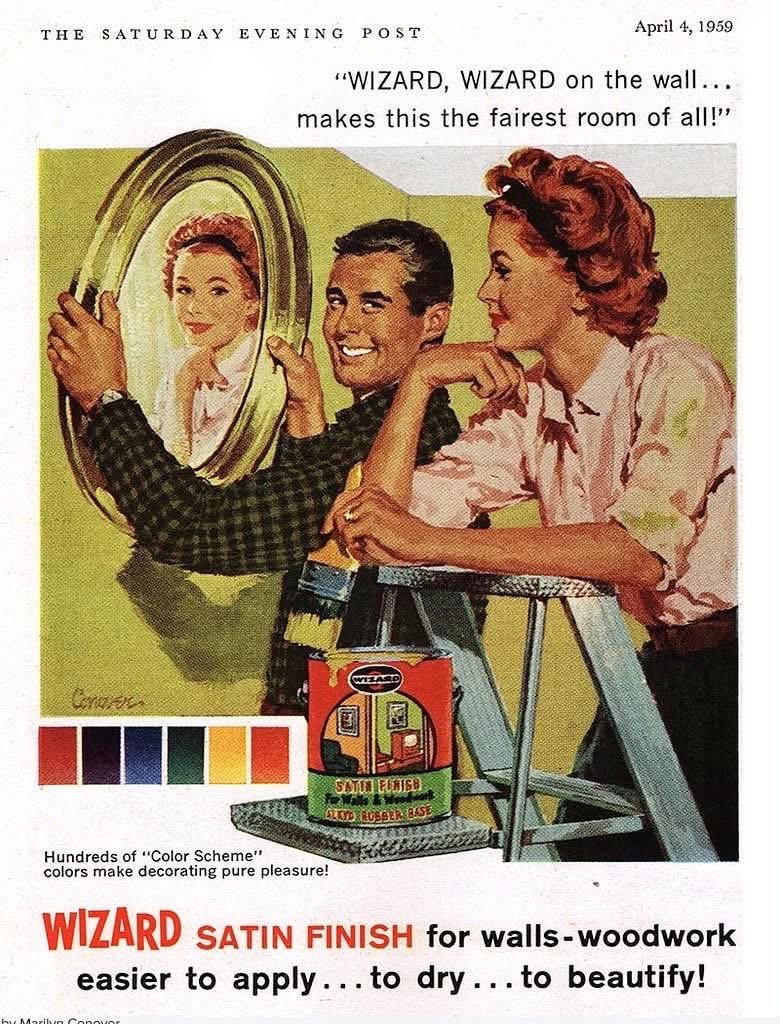
In an advertisement appearing in The Saturday Evening Post dated April 4, 1959, a family gathers around a newly placed mirror, with a ladder, a can of Wizard Satin Finish, and a small palette suggesting hundreds of decorating possibilities. The advertisement wasn’t simply selling paint. It was selling an appealing idea for its time: color and a little work at home could make a familiar room feel new again. What can this advertisement tell us about color, decorating, and home improvement more than six decades ago?
Article Content
Home Colors in 1959… When Redecorating Became Part of Making a Home Beautiful
The first thing that catches the eye isn’t the paint can.
It’s the mirror.
A man holds it against the wall, a woman watches beside him, and a child’s face appears in its reflection.
Above them is a playful twist on the famous Snow White mirror phrase:
“Wizard, Wizard on the wall…”
The mirror isn’t simply decoration.
It helps tell a tiny story:
Look at your room—and imagine what it could become.
Color Was Becoming More Than Wall Coverage
A row of different colors appears near the bottom of the advertisement, accompanied by a reference to hundreds of “Color Scheme” choices.
The message moves beyond:
This wall needs fresh paint.
Toward:
What do you want your home to look like?
Paint becomes not only maintenance, but a tool for choice, taste, and decorating.
A Paint Can—But the Advertisement Sells Change
The Wizard Satin Finish can occupies relatively little space compared with the family scene.
Instead, we see people, a mirror, a ladder, colors, and home improvement in progress.
The product becomes the means to an outcome:
a more beautiful home.
It’s an advertising principle that remains familiar today.
Products are often sold through the result or feeling they promise to create.
Making the Job Feel Easier
The advertisement emphasizes ease—application, drying, and beautifying.
Other newspaper advertising for Wizard Satin Finish during the 1950s similarly promoted its use on walls and woodwork, ease of application, and a choice of colors.
The message wasn’t simply:
Here is paint.
It was also:
Changing your room doesn’t have to feel impossibly complicated.
Who Is Doing the Work?
One of the most interesting details is the family itself.
The man is holding the mirror.
The woman stands beside him.
The child appears in the reflection.
There is no professional decorating crew.
The improvement is happening inside ordinary family life.
That makes the transformation feel attainable:
This could happen in your home too.
The Woman Is Part of the Message
The woman’s presence is prominent, connecting the product with domestic decoration, appearance, comfort, and the presentation of the home.
Seen today, this also makes the advertisement a document of its period.
Mid-century advertising frequently addressed women through ideas about the home, decorating, beauty, comfort, and domestic responsibility.
That tells us something not only about what was being sold, but about the social expectations advertisers used to communicate with their audience.
Turning Work Into Pleasure
The advertisement describes decorating with its many color choices as “pure pleasure.”
That word matters.
Painting involves preparation, tools, moving objects, cleaning, time, and effort.
But the advertisement reframes the task.
It’s no longer merely maintenance.
It becomes creative home decorating.
A household chore is transformed into an opportunity for choice and renewal.
Why Show So Many Colors?
The small palette communicates possibility.
The consumer isn’t simply repairing a wall.
She can help decide what personality the room should have.
Today we have digital color visualizers, mood boards, inspiration platforms, and endless interior photographs.
In 1959, a magazine advertisement itself could provide part of that inspiration.
From a Magazine Page to a Phone Screen
Today, someone considering a new wall color can compare hundreds of rooms within minutes.
In 1959, a magazine page like this performed some of that imaginative work.
It presented the idea, the colors, the lifestyle, and a picture of transformation.
Advertising wasn’t merely informing consumers about products.
It was helping them imagine possibilities for their homes.
And Finally… the Mirror
Return to the mirror once more.
The advertisement playfully promises that Wizard on the wall can make the room more beautiful.
But the mirror adds another layer.
It connects looking, beauty, and transformation.
The real question becomes less:
What color is this paint?
And more:
What could my room look like after the change?
In the End…
At first glance, this 1959 page is simply an advertisement for a can of paint.
But it preserves something larger:
a moment when color, decorating, and home improvement were being presented as part of creating a more attractive modern home.
The family isn’t standing inside a completely new house.
They’re changing the home they already have.
And perhaps that’s why the idea still feels so familiar.
Sometimes renewal doesn’t begin with replacing everything.
It can begin with something as simple as:
a different color on the wall.
“Vintage advertisements preserve more than the colors of old homes… they also preserve the ways each generation learned to imagine a more beautiful one.”
Memories of Days Gone By ᥫ᭡
Rana Elgogary
Expert Tip
«When looking at an old advertisement for a household product, don’t focus only on what was being sold. Look at the life built around the product. Who is doing the work? Who is the advertisement speaking to? What feeling does the product promise to create? Those details can turn a vintage advertisement into a small window onto everyday life in another era. Memories of Days Gone By ᥫ᭡ Rana Elgogary»
Conclusion
This Wizard Satin Finish advertisement is dated April 4, 1959, and presents paint through a family scene filled with color, decorating tools, and the process of improving a room. Other Wizard advertising from the 1950s similarly promoted Satin Finish for walls and woodwork while emphasizing ease of application and color choice. Today, its value goes beyond paint history. It offers a glimpse into the way color, decorating, and home improvement were being connected with taste and modern domestic life. Tip of the Day When looking at an old advertisement for a household product, don’t focus only on what was being sold.