5 min read
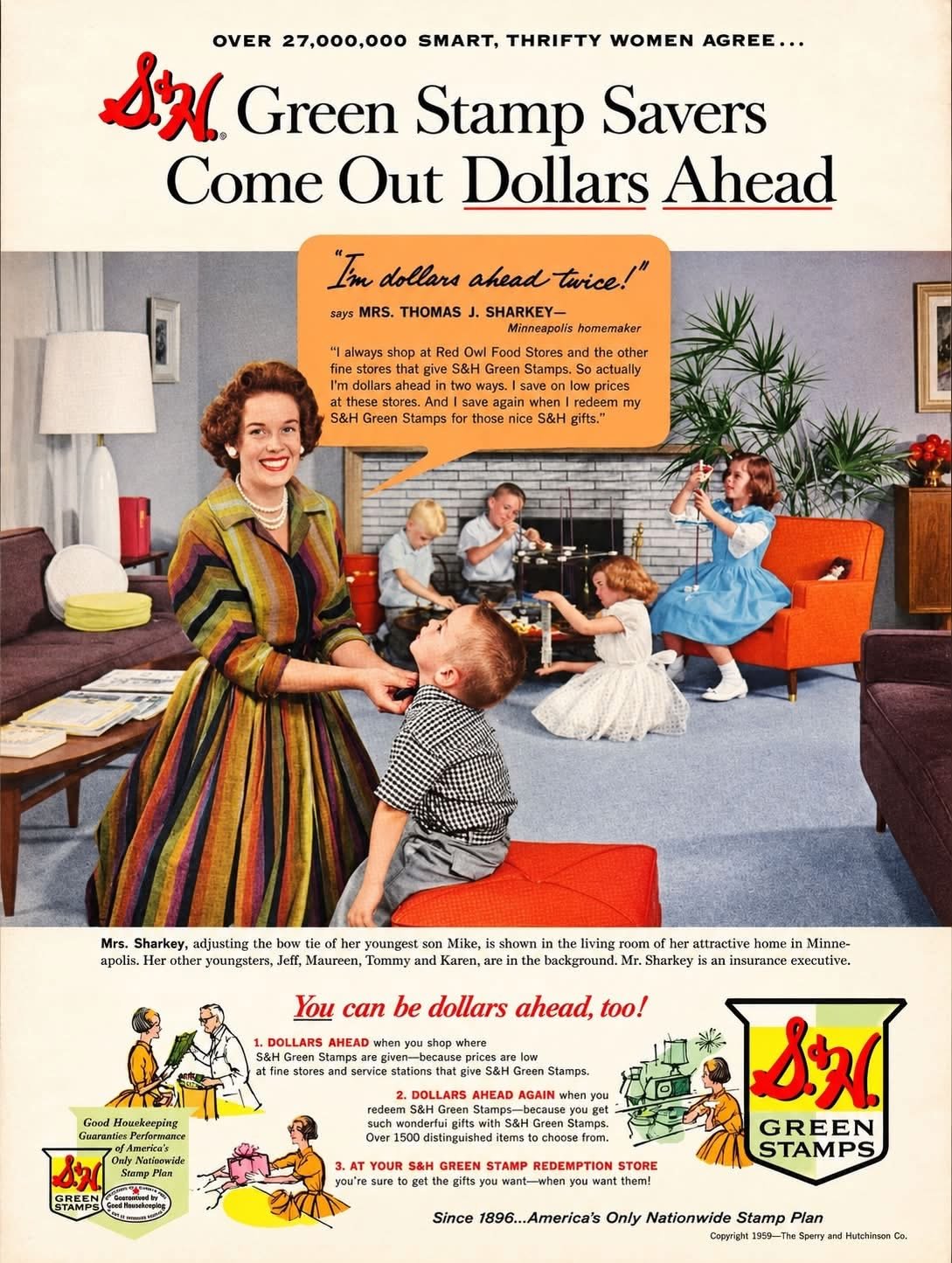
Before apps, digital points, and loyalty cards, American shoppers collected small green paper stamps and pasted them into books. In this 1959 S&H Green Stamps advertisement, a homemaker is presented as coming out “dollars ahead” twice: first by shopping at participating stores and then by redeeming accumulated stamps for merchandise. The page captures an important moment in consumer history, when ordinary purchases became steps toward a future reward.
Article Content
How Did S&H Green Stamps Work?
Sperry & Hutchinson was founded in 1896 by Thomas Sperry and Shelley Byron Hutchinson.
Participating retailers purchased S&H stamps and distributed them to customers according to their purchases. Shoppers saved the stamps in collector books and later exchanged completed books for merchandise through S&H catalogs or redemption centers.
Rewards included household goods, lamps, furniture, bicycles, and many other products.
The reward was therefore not usually cash.
It was future merchandise earned through accumulated shopping.
“Dollars Ahead Twice”
The advertisement’s central claim is that the shopper benefits twice.
First, it argues that participating shops can still offer competitive prices.
Then the shopper gains another benefit when the stamps are redeemed for merchandise.
These statements should be understood as advertising claims, rather than universal economic facts.
The U.S. copyright catalog documents this specific Mrs. Thomas J. Sharkey version of the campaign in LIFE, dated September 28, 1959.
An Early Loyalty Program
The underlying strategy feels remarkably familiar today.
Buy → accumulate value → redeem a reward.
Smithsonian describes S&H as an early large-scale loyalty program that expanded through department stores, grocery stores, and other retailers before becoming enormous in the 1960s.
The main difference is technological.
Today’s points sit in an account.
S&H points were represented by physical stamps pasted into physical books.
Making Progress Visible
A stamp book allowed shoppers to see progress toward a reward.
Each newly filled space brought the desired item closer.
That visible accumulation helped transform ordinary shopping into a longer-term reward process.
Customers did not simply buy groceries and leave.
They left with something that encouraged them to think about their next visit.
Why Is the Homemaker at the Center?
The advertisement does not address a generic “consumer.”
It speaks directly to women and features a mother inside her family home.
Its message connects Green Stamps with careful household budgeting.
Being a smart shopper is presented almost as part of successful homemaking.
The page therefore documents both the history of loyalty marketing and the gendered language through which household consumption was advertised in the late 1950s.
From Green Stamps to Digital Points
The format has changed dramatically:
stamp → digital point
book → app
catalog → online store
redemption center → “Redeem” button
But the commercial logic remains familiar.
Reward repeated purchasing and give customers another reason to return.
“Before shopping rewards became numbers inside an app, they were little pieces of paper pasted into a book. The tools changed, but the idea of making every purchase move us closer to a reward remained.”
Memories of Days Gone By ᥫ᭡
Rana Elgogary
Expert Tip
«When looking at a vintage advertisement that promises something “free,” don’t ask only: “What is the reward?” Also ask: “What behavior is the program encouraging me to repeat in order to earn it?” Behind many rewards is a simple marketing principle: the reward recognizes the previous purchase—but it may also encourage the next one. Memories of Days Gone By ᥫ᭡ Rana Elgogary»
Conclusion
The advertisement documents an S&H Green Stamps campaign published in LIFE in 1959, presenting stamp collecting as a way for families to receive additional value from everyday purchases. The S&H program, founded in 1896, allowed shoppers to receive stamps from participating retailers, paste them into collector books, and exchange completed books for merchandise through catalogs or S&H redemption centers. The advertisement also shows how loyalty rewards were connected to the homemaker’s role in managing household spending. The system represents an early form of the customer-loyalty programs that have since moved from paper stamps and books to digital points and apps.