5 min read
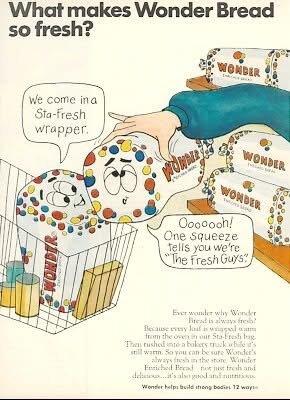
Talking loaves, a hand squeezing a package, and one simple question: “What makes Wonder Bread so fresh?” In Wonder Bread advertising from the early 1970s, freshness was presented not only as a quality of the bread but as a story involving its Sta-Fresh wrapper, packaging, and distribution. The advertisement captures a moment when packaging itself became something brands could actively sell.
Article Content
Bread in 1972… When the Wrapper Became Part of the Promise of Freshness
Short Description
Talking loaves, a hand squeezing a package, and one simple question:
“What makes Wonder Bread so fresh?”
In Wonder Bread advertising from the early 1970s, freshness was presented not only as a quality of the bread but as a story involving its Sta-Fresh wrapper, packaging, and distribution.
The advertisement captures a moment when packaging itself became something brands could actively sell.
When the Wrapper Became Part of the Product
Wonder’s advertising described the Sta-Fresh plastic bag as helping retain moisture and featured a twist-style closure that could be opened and closed again. These were advertising claims made by the company, but they reveal what Wonder considered important enough to emphasize to consumers.
The wrapper was no longer simply protection around the bread.
It became part of the product’s promised value.
From Oven to Store
A version of the campaign published in American Home in February 1972 explained that loaves were wrapped warm from the oven and moved into bakery trucks for distribution.
The important advertising idea was the sequence:
oven → wrapper → truck → store.
Instead of simply claiming freshness, the brand supplied a story that explained where that freshness was supposed to come from.
Meet “The Fresh Guys”
The anthropomorphic loaves gave the campaign personality.
Rather than using bread as a silent object, Wonder turned its loaves into characters—the “Fresh Guys.”
TIME reported in February 1972 that Wonder had adopted this animated-loaf freshness theme after an earlier campaign that focused much more heavily on children’s growth.
Freshness became the new central story.
The Nutrition Message Was Still There
At the bottom of the advertisement remained Wonder’s famous line:
“Wonder helps build strong bodies 12 ways.”
Growth and nutrition claims in Wonder’s earlier advertising later became part of Federal Trade Commission proceedings concerning how consumers could interpret those messages.
The advertisement therefore captures an interesting transition: an older nutrition message remained, while the main creative idea had shifted toward freshness and packaging.
An Old Brand Finding a New Story
Wonder Bread itself dates to 1921, according to the company’s official history. The brand later benefited from the growing popularity of pre-sliced bread in the 1930s.
By the early 1970s, the challenge was no longer introducing Wonder.
It was finding a new reason for consumers to notice it.
The Sta-Fresh campaign made packaging that reason.
“One Squeeze” Turns Freshness Into an Experience
Freshness is difficult to demonstrate in a printed page.
So the advertisement gave shoppers a simple imagined test:
squeeze the loaf.
Touch transformed an abstract quality into something the consumer could supposedly experience personally.
The product became interactive before the package was even opened.
More Than Bread
The advertisement sells bread, but it also sells:
freshness,
packaging technology,
distribution speed,
softness,
and confidence in what the shopper will find on the shelf.
That is what makes this page especially interesting today.
Packaging has become so normal that we often barely notice it.
Yet in this advertisement, the wrapper is important enough to become the main explanation for why the product should be chosen.
“Vintage advertisements preserve more than the products people bought. They preserve the moments when details we now consider ordinary were new enough to become the entire advertising story.”
Memories of Days Gone By ᥫ᭡
Rana Elgogary
Expert Tip
«When looking at an old food advertisement, don’t study only the food. Ask: “Is the company selling the product—or also the way it was packaged, protected, and delivered?” Sometimes the history of the wrapper tells us almost as much as the history of what was inside it. Memories of Days Gone By ᥫ᭡ Rana Elgogary»
Conclusion
The Wonder Bread campaign in the early 1970s focused on the Sta-Fresh wrapper and on the journey of the bread from the bakery to the store. It also used “The Fresh Guys” characters to turn the idea of freshness into a light, memorable story. The campaign appears in published sources from 1971 and 1972. The advertisement also shows how packaging and distribution became part of the product’s value itself, rather than the wrapper being treated as merely an outer layer that consumers would barely notice.