5 min read
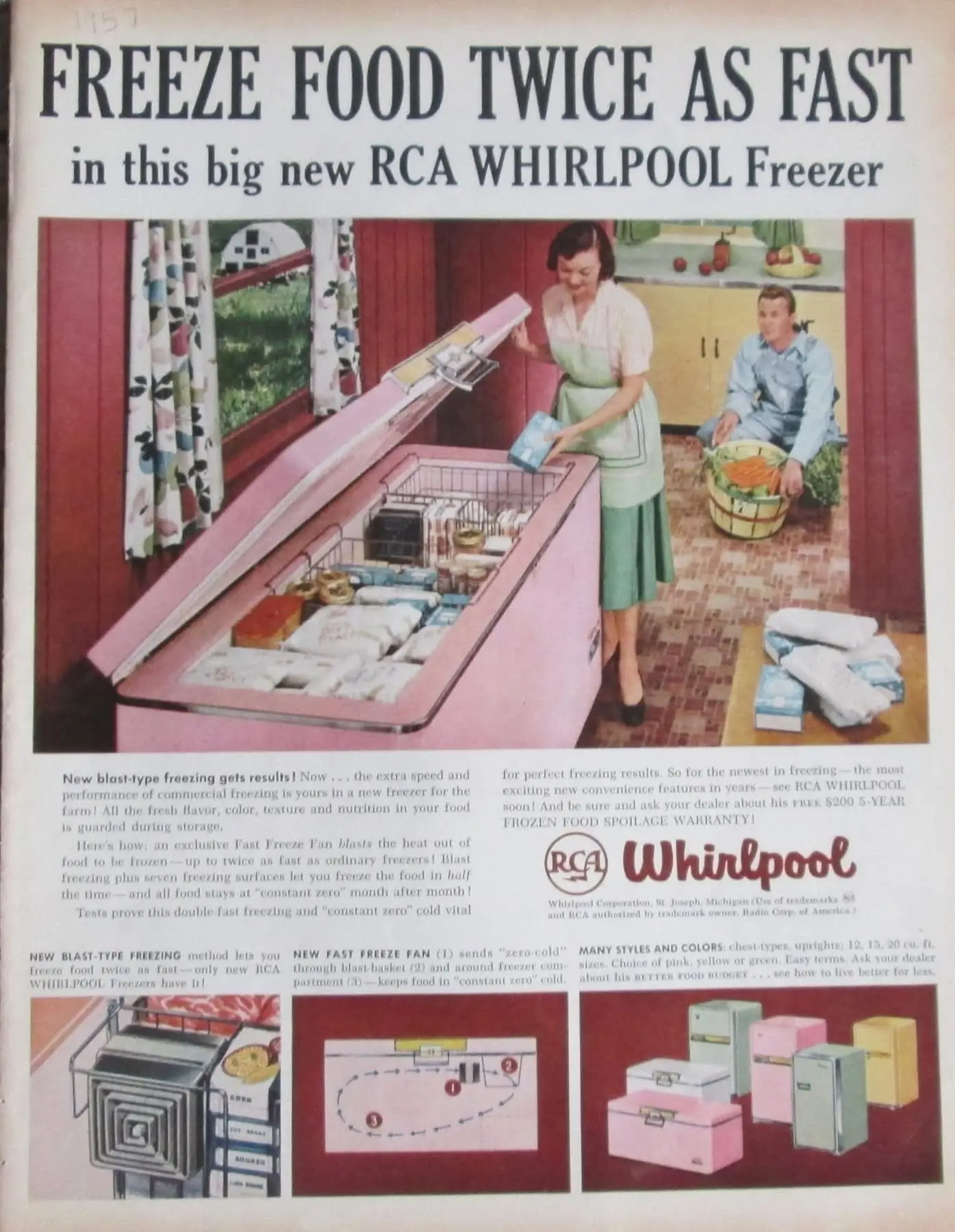
A large pink freezer, baskets of fresh vegetables, and enough stored food to last for weeks or months. This vintage RCA Whirlpool advertisement was selling more than additional freezer space. It promoted faster freezing, steady low temperatures, and the promise of preserving food’s flavor, texture, and quality. It captures a period when the home freezer was beginning to change the way families bought, stored, and planned their food.
Article Content
“Freeze Food Twice as Fast”
The advertisement’s main headline promises:
“FREEZE FOOD TWICE AS FAST.”
It attributes this to a blast-type freezing system and a Fast Freeze Fan designed to circulate very cold air around newly added food.
“Twice as fast” should be understood as the manufacturer’s advertising claim.
However, the underlying principle—that rapid freezing can improve frozen-food quality—is scientifically sound.
The USDA Food Safety and Inspection Service explains that fast freezing limits the formation of large ice crystals. Slow freezing allows larger crystals to develop, which can damage cells and result in greater moisture loss and texture changes when food is thawed.
Why “Constant Zero” Mattered
The advertisement also emphasizes maintaining food at approximately 0°F (-18°C).
That remains consistent with modern USDA guidance, which recommends a freezer temperature of 0°F or below for long-term frozen-food storage and for preserving quality.
But freezing does not make food permanently perfect.
Food kept continuously frozen can remain safe for very long periods, while quality gradually declines with storage time.
Why Was a Large Freezer So Appealing?
The scene itself tells the story.
A woman loads the freezer while fresh vegetables arrive in large quantities behind her.
The appliance promised families the ability to preserve larger purchases, seasonal produce, prepared foods, and supplies for future meals.
Frozen foods were also becoming increasingly important in American life during the 1950s. The Smithsonian National Museum of American History notes that Swanson introduced its frozen TV Dinner in 1954, linking frozen food with convenience and changing domestic routines.
Hagley Museum and Library reports that an estimated seven million Americans owned combination refrigerator-freezers by 1956.
Why “RCA Whirlpool”?
The name itself dates the advertisement to an important period in Whirlpool’s history.
Whirlpool’s official historical record states that RCA-Whirlpool became a brand name in 1955, and the first complete line of RCA-Whirlpool home appliances was introduced in 1956, covering twelve appliance categories and 150 models.
The RCA name continued to appear with Whirlpool until the mid-1960s, after which the brand became simply Whirlpool.
A Pink Freezer Was Part of the Message
One of the most striking details is the color.
The advertisement presents the freezer in pink and shows several appliance color choices.
The appliance was no longer being treated purely as machinery.
It was becoming part of the visual design of the kitchen.
Technology was also becoming home décor.
Freezing Preserves Food—It Does Not Sterilize It
Modern food-safety science adds an important correction.
USDA explains that freezing at 0°F inactivates many microorganisms and stops their growth while food remains frozen, but it does not necessarily destroy them.
Once food is thawed, microorganisms can become active again, so thawed foods still require safe handling.
A freezer preserves food.
It does not sterilize it.
What Does This Advertisement Preserve for Us Today?
It preserves the pastel color, the chest-freezer design, and an idealized mid-century kitchen.
But it also preserves a much bigger change in domestic life.
Home freezing allowed families to think beyond:
“What will we cook today?”
and increasingly toward:
“What can we buy, prepare, and preserve for later?”
“Sometimes a household appliance changes more than the appearance of a kitchen—it changes how families buy food, plan meals, and preserve something today for use in the future.”
Memories of Days Gone By ᥫ᭡
Rana Elgogary
Expert Tip
«When you look at an old household appliance, don’t ask only: “What did it look like?” Also ask: “What everyday habit changed when this appliance entered the home?” The freezer did more than provide additional cold storage. It changed how families bought, preserved, and planned their food. Memories of Days Gone By ᥫ᭡ Rana Elgogary»
Conclusion
This mid-century RCA Whirlpool advertisement reflects the rapid growth of home freezers and frozen foods, emphasizing faster freezing, steady low temperatures, and large storage capacity as benefits for the modern household. RCA-Whirlpool became a brand in 1955, and its first complete appliance line appeared in 1956. Modern food science supports the basic principle behind fast freezing: rapid freezing helps protect food quality by limiting the formation of large ice crystals, while 0°F or below remains the recommended freezer temperature. Freezing, however, does not sterilize food, and quality can still decline during prolonged storage.