5 min read
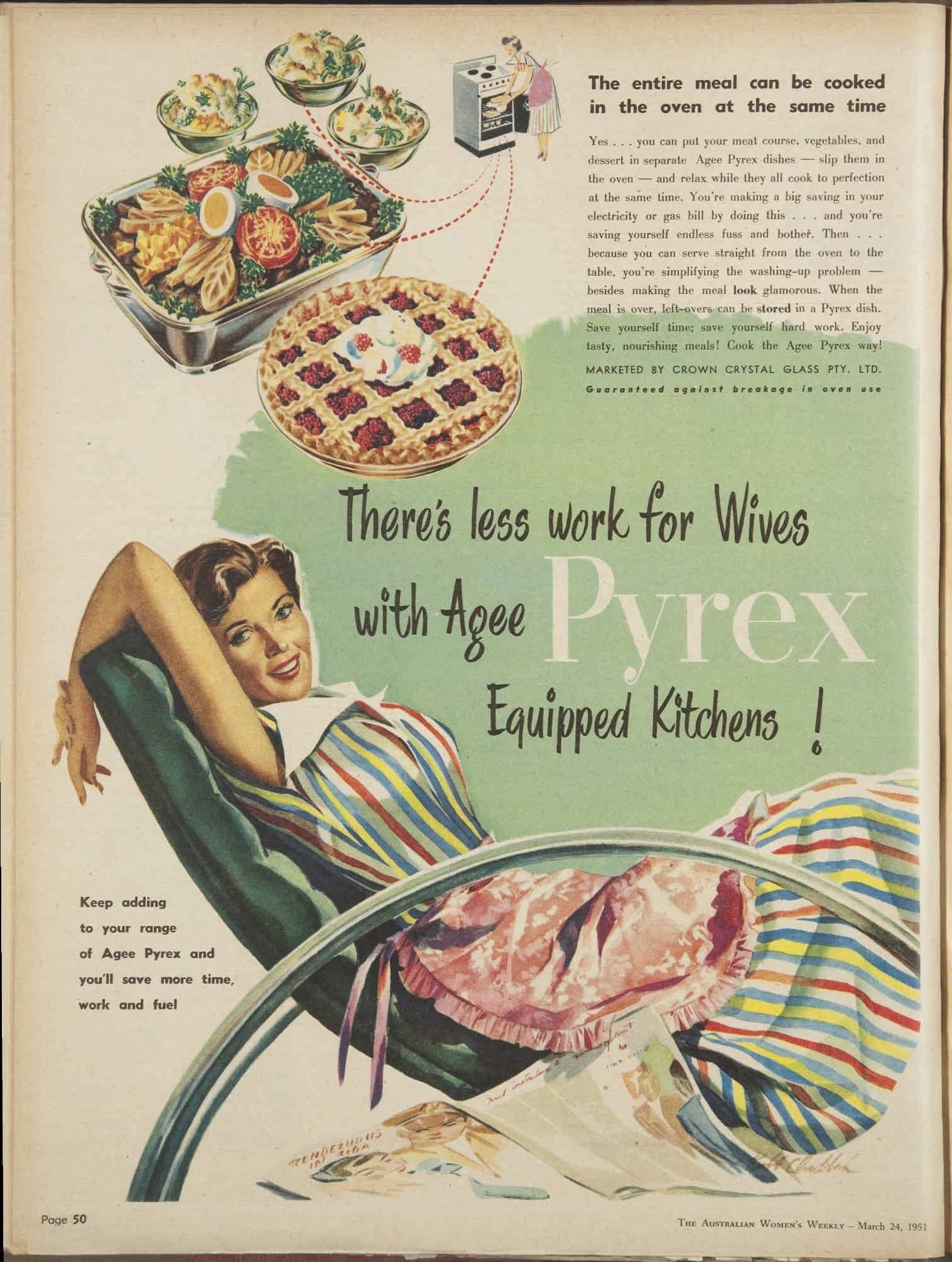
A woman relaxes away from the stove while an entire meal is shown cooking in glass ovenware. Published in The Australian Women’s Weekly on March 24, 1951, this Agee Pyrex advertisement makes its promise explicit: “There’s less work for wives.” But the page sells more than cookware. It sells fewer steps, less washing up, and more free time—while also revealing how domestic work and women’s roles were framed in mid-century advertising.
Article Content
One Oven, an Entire Meal
The advertisement’s headline states:
“The entire meal can be cooked in the oven at the same time.”
Meat, vegetables and dessert are shown in separate Agee Pyrex dishes, all visually connected to a single oven.
The copy presents this method as a way to save time, reduce fuss and use less fuel or electricity.
Those should be read as advertising claims made by the original campaign, rather than universal instructions for every oven or recipe.
What matters historically is the need the advertisement was addressing:
Less time and less labor in the kitchen.
Cook, Serve, and Store
The advertisement also promotes the idea of taking food directly from the oven to the table in the same dish and later storing leftovers in it.
The product therefore becomes more than bakeware.
It promises a sequence:
Cook → Serve → Store
That idea continued in later Agee Pyrex advertising. The Corning Museum of Glass preserves a 1958 Australian advertisement describing the product as useful for cooking, serving and storing.
One dish could potentially replace several stages of the meal.
Less Washing Up Was Part of the Product
The advertisement explicitly connects the cookware with reducing washing up.
This tells us something important about domestic-product advertising.
The benefit was not simply:
“This is a good glass dish.”
It was:
“This dish may eliminate some of the work surrounding the meal.”
A cooking dish could become a serving dish.
Leftovers could remain in the same container.
Several foods could share the oven.
Efficiency itself became part of the product.
What Was Agee Pyrex?
The Powerhouse Collection identifies Agee Pyrex as Australian-made glassware and holds records related to Australian Glass Manufacturers and Crown Crystal Glass, including manufacturing records from the 1930s through the early 1950s that refer to Pyrex samples and products.
The advertisement itself identifies Crown Crystal Glass Pty. Ltd. as the marketer.
So the page is also part of the history of Australian domestic glass manufacturing—not merely a transplanted American campaign.
The Most Revealing Word Is “Wives”
The main slogan does not say:
“Less work in the kitchen.”
It says:
“Less work for Wives.”
That distinction matters.
The advertisement assumes that the person responsible for this domestic work is the wife.
Its promise is not to challenge that responsibility.
Instead, it offers tools that supposedly make the role easier and more efficient.
This should not be treated as proof that every Australian woman lived this way in 1951.
Rather, it reveals the audience and household role the advertiser chose to imagine and address.
Even Relaxation Becomes Part of the Sale
The woman in the lower half of the advertisement is not cooking.
She is reclining.
Smiling.
Away from the stove.
That image is essential to the message.
Agee Pyrex is not only selling glass dishes.
It is selling the time the woman is supposed to gain by using them.
The same strategy remains familiar today.
Products are often sold not only through what they do, but through what the consumer might do with the time or effort they save.
Why Show an Entire Meal?
The advertisement does not place one small dish beside the oven.
It displays a complete spread:
a main course, vegetables, and dessert.
The dotted lines visually connect all of them to one oven.
Before the reader reaches the long copy, the graphic has already delivered the idea:
Many dishes. One oven.
The advertisement is presenting the cookware as part of a whole system of meal preparation rather than a single-purpose object.
Convenience Was the Real Product
At first glance, the advertisement sells Agee Pyrex.
Look more closely and it sells:
fewer steps,
less washing up,
fewer utensils,
and more personal time.
That basic promise remains central to domestic-product marketing today.
The technology has changed.
The desire has not:
“Give me some of my time back.”
From the 1951 Kitchen to Today
Modern kitchens contain multifunction ovens, air fryers, dishwashers, programmable cookers and containers designed to move between storage, heating and serving.
We still value products that reduce steps and repetitive work.
But the language used to sell them has changed.
That is what makes this 1951 advertisement especially revealing.
It preserves both the evolution of household technology and the evolution of how society talks about who performs household work.
“Vintage advertisements reveal more than how household tools changed. They also show who was expected to perform the work—and what each era understood as convenience and modernity.”
Memories of Days Gone By ᥫ᭡
Rana Elgogary
Expert Tip
«When you look at an old advertisement for a household product, don’t ask only: “What did this product do?” Also ask: “Who did the advertisement assume was responsible for doing this work?” That question can turn a simple old advertisement into a small historical record of everyday life. Memories of Days Gone By ᥫ᭡ Rana Elgogary»
Conclusion
This Agee Pyrex advertisement appeared in The Australian Women’s Weekly on March 24, 1951 and promoted simultaneous oven cooking, oven-to-table serving, easier storage and reduced washing up. The Powerhouse Collection documents Agee Pyrex as part of Australian glass manufacturing, while the Corning Museum of Glass preserves later Australian Agee Pyrex advertisements emphasizing cooking, serving and storing. The advertisement is equally interesting for its social language: it explicitly presents domestic labor as work performed by “wives” and sells convenience as a way of making that role easier.