5 min read
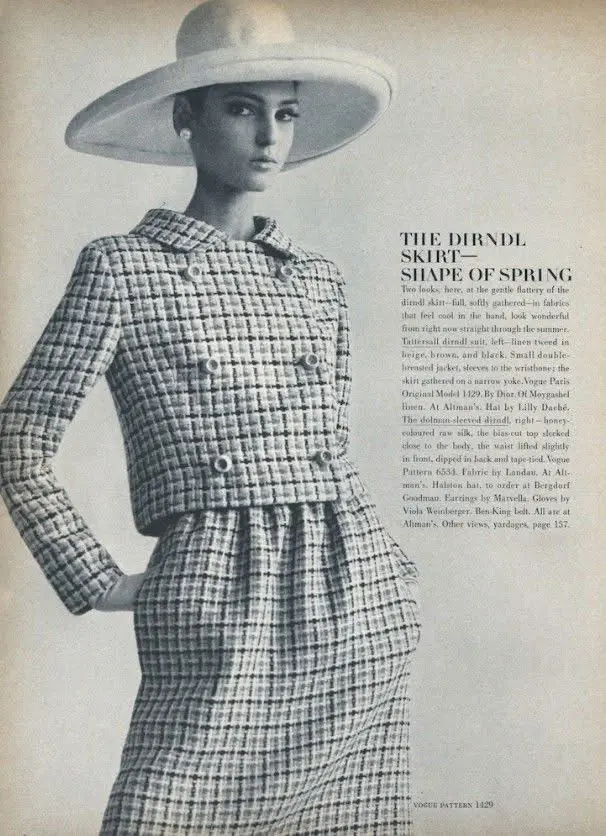
A short jacket, softly gathered skirt, and wide-brimmed hat: a closer look at a Vogue ensemble balancing structured lines with gentle fullness.
Article Content
In this black-and-white page, a short jacket and gathered skirt are paired with a wide-brimmed hat. A repeated checked pattern connects the ensemble, while the cuts create differences in shape and volume.
Vogue’s archive dates “The Dirndl Skirt—Shape of Spring,” published in its Vogue Patterns section, to March 15, 1965.
What is a dirndl skirt?
In sewing terminology, a dirndl skirt gains fullness from fabric gathered at the waist. An educational reference preserved in ERIC describes its construction as a straight piece of fabric gathered at the waist. Its volume therefore does not necessarily come from a circular cut.
What does the page tell us?
The visible text attributes the suit to Dior and identifies Vogue Paris Original pattern 1429. It describes a double-breasted jacket with wrist-length sleeves and a skirt gathered onto a narrow waistband.
This credits the house of Dior; it does not, by itself, establish personal authorship by Christian Dior.
How can we read the design?
As a visual interpretation, the short jacket defines the upper section, with the gathers introducing fullness below it. Matching fabric connects the separates, while the hat creates a prominent horizontal shape around the face.
Although the photograph is monochrome, the accompanying text identifies beige, brown, and black in the tweed. Those colours come from the written description, rather than guesswork.
From the memory of days, this page invites us to understand an outfit through its construction: where a garment ends, where fabric gathers, and how lines connect clothing and accessories.
Your Image & Presence
Rana Elgogary ᥫ᭡
Expert Tip
«When studying vintage fashion, distinguish visible details from written descriptions, and identify whether fullness comes from gathers, pleats, or a flared cut.»
Conclusion
A 1965 Vogue ensemble pairs a short jacket with a waist-gathered dirndl skirt, revealing how cut, fabric, and accessories shape a composition.