5 min read
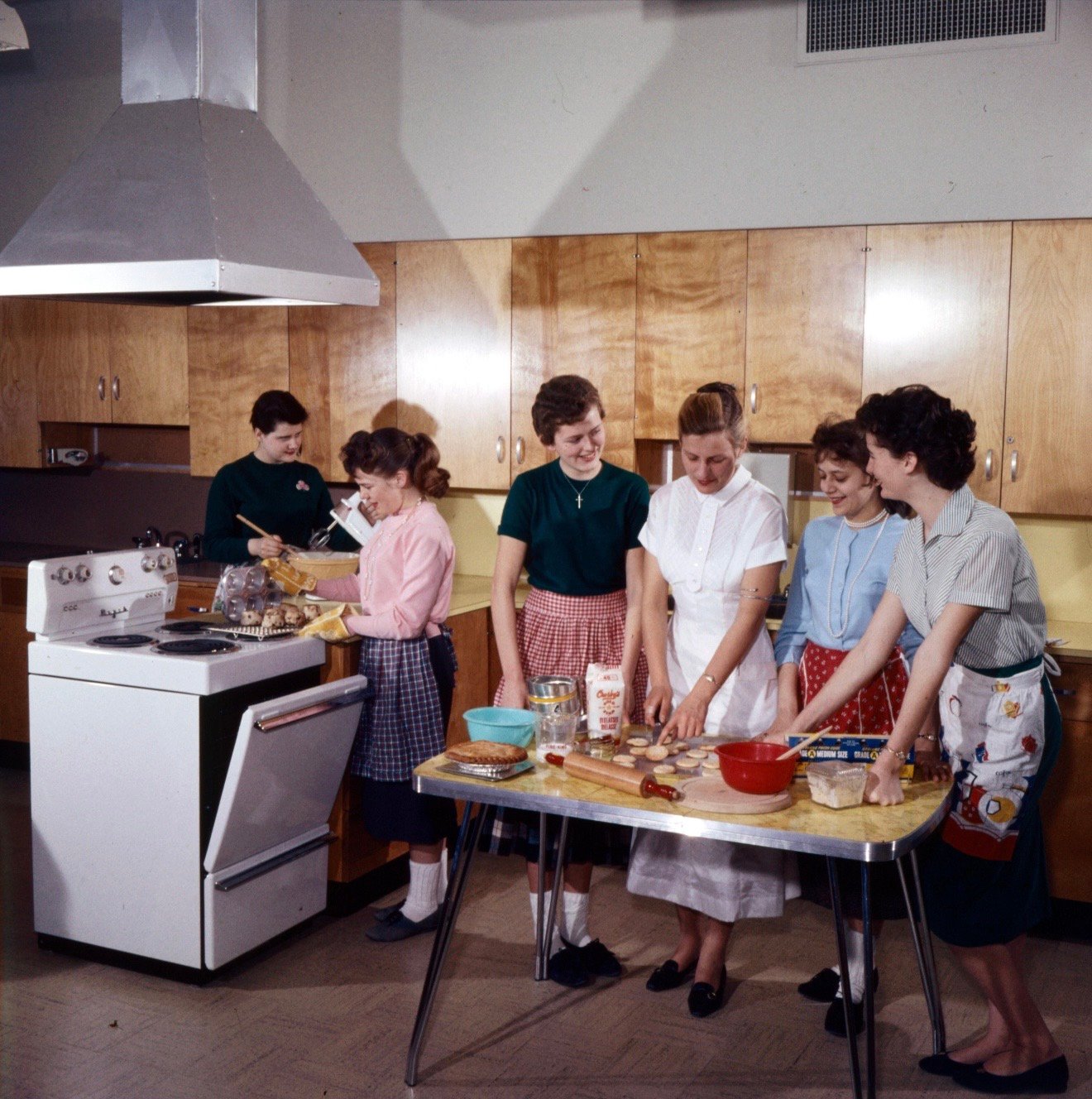
A vintage photograph of a home economics class takes us back to a time when skills such as food preparation, sewing, and household management were taught in the classroom. What did students actually learn in these classes, and what can they tell us about education, everyday life, and social roles of their time?
Article Content
Home Economics Classes of the Past… When Life Skills Were Part of the School Day
Some old photographs need very little explanation to transport us to another time.
A classroom, a group of female students wearing aprons, and kitchens and utensils that look as though they have been moved from a home directly into a school.
This was Home Economics, a subject taught in many schools and educational institutions throughout the twentieth century.
But what did students actually learn in these classes?
And was home economics simply about cooking?
It Was More Than a Cooking Class
A kitchen may be the first image that comes to mind when we hear the term “home economics,” but the field was much broader.
Historical home economics curricula covered a variety of subjects, including food preparation and nutrition, sewing, textiles and clothing, laundry and household care, family budgeting, consumer choices, and aspects of home planning and furnishing.
The idea was to turn some of the practical skills associated with everyday life into knowledge that could be studied and practiced in an organized way.
That is why some home economics classrooms looked very different from traditional classrooms.
Instead of rows of desks and a blackboard alone, they could contain ovens, sinks, worktables, and cooking equipment. Other classrooms might include sewing machines, fabrics, and ironing equipment.
How Did These Subjects Enter Education?
The roots of teaching domestic and practical life skills in schools go back much further than the photographs from the 1950s and 1960s that we often see today.
In the United States, organized educational programs began introducing subjects such as sewing and cooking into girls’ education during the late nineteenth century.
Over time, home economics developed into a more structured field of education, accompanied by specialized textbooks and curricula.
Science Entered the Kitchen Too
There is another side to these photographs that may not be immediately obvious.
As home economics developed, the aim was not always simply to teach students how to perform a task, but also to understand why it was done in a particular way.
Nutrition, health, science, materials, textiles, and household technology became part of the field.
As electricity and household appliances became more widespread, new knowledge about using these technologies also entered home economics education.
In this sense, the kitchen could become a place of practical learning rather than simply a place for preparing food.
The Photograph Also Tells Us About Its Time
When looking at old home economics classes, it is important to consider the society in which they existed.
For long periods, home economics education was associated much more closely with girls and women than with men, reflecting societies in which household management, cooking, sewing, and family care were often presented primarily as women’s responsibilities.
These photographs therefore tell two stories at once.
They document the teaching of useful practical skills, but they also reveal a great deal about the social roles that women were expected to fulfil at the time.
Look Closely at the Classroom
This is where the photograph becomes even more interesting.
Do not look only at what the students are doing.
Notice their clothing and aprons, their hairstyles, the design of the ovens, the work surfaces, the utensils, and the arrangement of the room.
Even the classroom itself tells a story.
We are not simply looking at a lesson. We are seeing part of the history of education, home design, technology, fashion, and society’s approach to everyday life.
That is precisely what makes archival photographs so fascinating.
A detail that seemed completely ordinary to the people who lived with it can, decades later, become a small historical record of what life once looked like.
From Home Economics to a Broader Concept
Education and society have changed considerably since these photographs were taken, and so has the way we think about life skills, households, and families.
Terminology has evolved as well. In the United States, Family and Consumer Sciences is now widely used for a field that developed from home economics and expanded to cover many aspects of individual and family life.
But when we look at an old home economics classroom today, perhaps the most interesting question is not simply:
“What were these students learning?”
It may also be:
“What skills should we teach new generations today to help prepare them for everyday life?”
Times change, tools change, and curricula change…
But knowing how to care for oneself, manage resources, and deal with the practical needs of everyday life remains knowledge worth learning.
Memories of Days Gone By ᥫ᭡
Rana Elgogary
Expert Tip
«Look closely at the details in old photographs… A classroom can tell us not only what people were learning, but also how they lived and how society viewed the world around them. Memories of Days Gone By ᥫ᭡ Rana Elgogary»
Conclusion
Home economics was historically much more than a cooking class. It covered a broad range of practical skills and knowledge related to food and nutrition, sewing and textiles, clothing, household management, budgeting, and more. Vintage photographs of these classes also reveal fascinating details about education, everyday life, and social roles in different periods.