5 min read
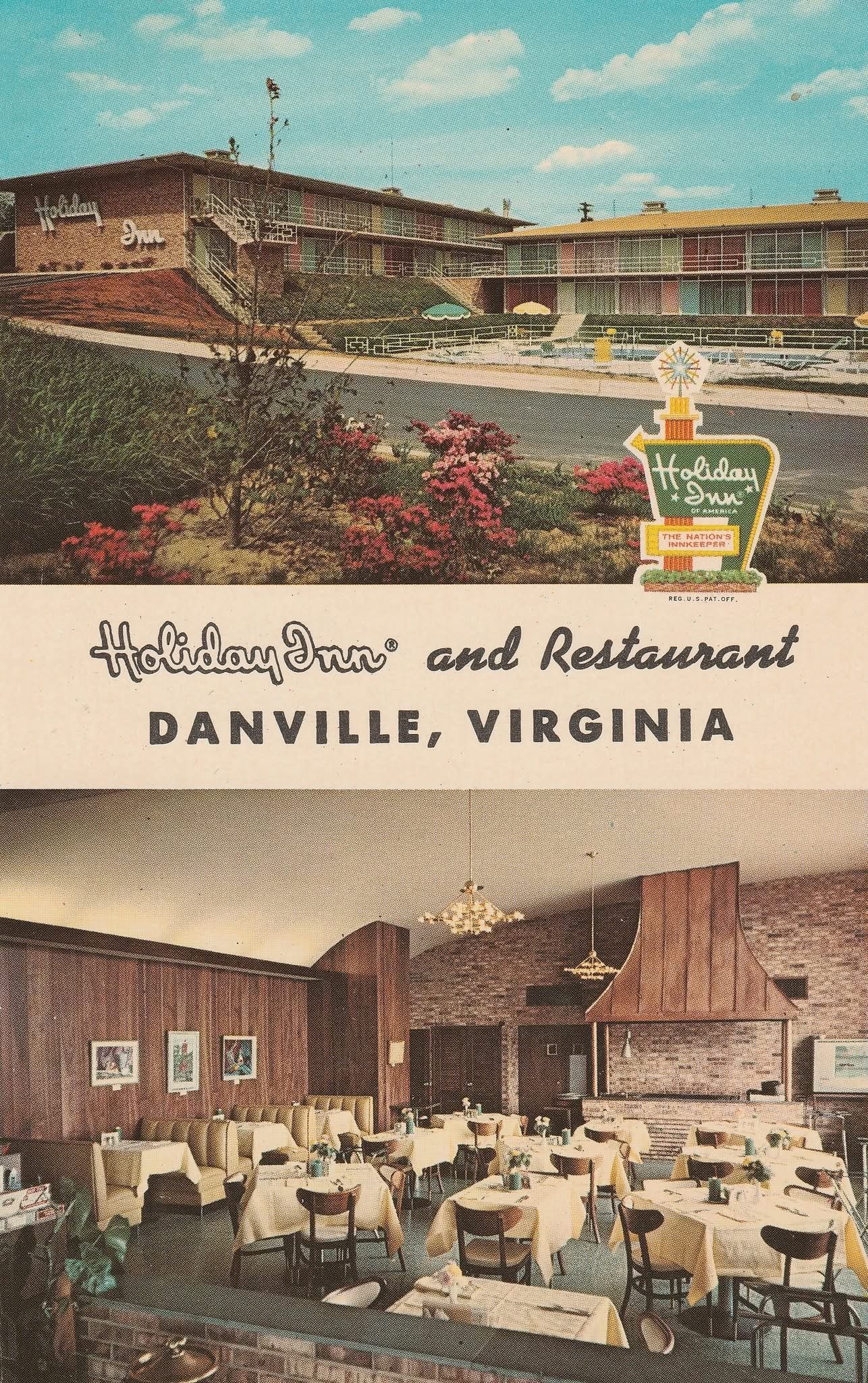
A swimming pool at the center, guest rooms around it, a full restaurant and a large sign visible from the road. This vintage postcard takes us to the Holiday Inn and Restaurant in Danville, Virginia, during an era when automobile travel was reshaping American hospitality and hotel chains were changing what travelers expected from an overnight stop. It was no longer simply about finding a room. It was increasingly about knowing what kind of experience might be waiting when you arrived.
Article Content
A Hotel Designed for the Road
The postcard presents two carefully selected views.
Above, we see the exterior: a low-rise motor hotel arranged around a swimming pool, landscaped grounds and the recognizable Holiday Inn roadside sign.
Below, we see the restaurant with neatly dressed tables, pendant lighting and a large fireplace.
The card identifies the property as the Holiday Inn and Restaurant in Danville, Virginia, located at the intersection of U.S. 29 By-Pass and U.S. 58.
That location tells us something important.
This was a place designed to meet people while they were traveling.
Making the Unknown More Predictable
The Smithsonian’s National Museum of American History explains that, after World War II, chains including Holiday Inn, Howard Johnson and Best Western established a new standard for roadside lodging and reduced some of the uncertainty associated with long-distance automobile travel.
A traveler might never have visited Danville before.
But recognizing a familiar hotel name could make the stop feel less unknown.
The brand itself became part of the promise.
A Family Trip Behind the Idea
IHG traces Holiday Inn’s origin to a family road trip taken by founder Kemmons Wilson, who became dissatisfied with the lodging available to families.
The first Holiday Inn opened in Memphis, Tennessee, in 1952.
IHG notes that early Holiday Inns offered features that now seem ordinary—including televisions, in-room telephones, air conditioning, parking, restaurants and swimming pools—while aiming to remain affordable for ordinary travelers.
Today those details may sound routine.
At the time, together they helped define a new expectation of roadside comfort.
The Pool Was Part of the Message
Notice how prominently the swimming pool appears.
It is not hidden behind the building.
It sits at the center of the visual experience.
The motel was therefore not presented simply as:
a bed for the night.
The photograph suggests rest, recreation and the possibility that an overnight stop could become part of the enjoyment of the trip itself.
Why Show the Restaurant?
The postcard’s second image is not a bedroom.
It is the dining room.
That choice matters.
The message was not merely:
“You can sleep here.”
It was also:
“You can arrive, eat, rest and continue your journey from here.”
IHG notes the importance of on-site restaurants in the Holiday Inn model, making food service part of the broader guest experience.
The tablecloths, flowers, fireplace and carefully arranged room therefore sell more than food.
They sell hospitality.
Before Booking Apps
Today, a traveler can see dozens of photographs, compare hundreds of reviews and book a room in seconds.
The 1960s traveler depended much more heavily on signs, printed directories, recognizable brands and reservation systems.
In 1965, Holiday Inn introduced Holidex, an electronic reservation system that connected properties across the chain.
Long before hotels lived inside our phones, the industry was already working to make distant properties feel connected.
What Was the Postcard Really Selling?
A room?
A pool?
Dinner?
All of those things.
But perhaps most importantly, it was selling predictability.
A place where the car could stop.
A family could eat.
Travelers could rest.
And the journey could begin again the next morning.
The Smithsonian notes that hotel chains brought greater consistency to roadside travel, even as that standardization could reduce some of the local individuality found in independent lodging.
That tension still exists today:
Familiarity can make us feel secure, while uniqueness makes a place memorable.
“Before we chose hotels from a phone screen, a familiar name, a roadside sign and a photograph of a pool and restaurant could sometimes tell a traveler: you can stop here.”
Memories of Days Gone By ᥫ᭡
Rana Elgogary
Expert Tip
«When looking at an old hotel postcard, don’t study only the décor. Ask: “What did travelers need to see in this image to trust this place?” The pool, the sign and the carefully arranged restaurant may once have done the job that photographs, ratings and booking apps do for us today. Memories of Days Gone By ᥫ᭡ Rana Elgogary»
Conclusion
This vintage postcard of the Holiday Inn and Restaurant in Danville, Virginia captures an era when roadside hotels were becoming important parts of American automobile travel. Swimming pools, restaurants, recognizable branding and standardized services helped travelers know more clearly what to expect when they stopped somewhere unfamiliar—a transformation the Smithsonian identifies as an important change in postwar roadside lodging.