5 min read
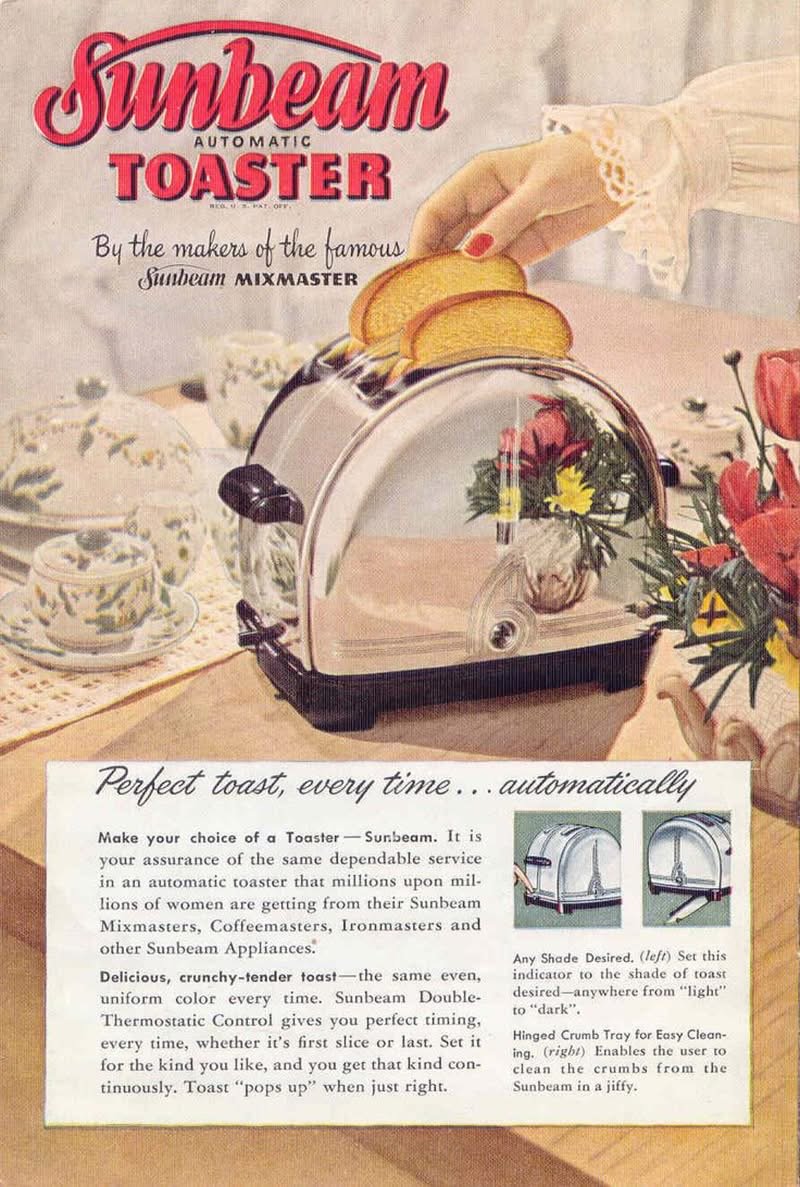
Two slices of bread, a gleaming chrome toaster, and a beautifully arranged breakfast table. Today, the scene seems ordinary. But late-1940s Sunbeam advertising presented automatic operation, consistent browning, adjustable toast shade, and easier cleaning as features of a more convenient modern kitchen. Today, we return to a vintage advertisement to explore how one small appliance helped turn “automatic” into a promise of the future.
Article Content
When Automation Was Part of the Dream
The advertisement makes its message immediately clear:
“Perfect toast, every time… automatically.”
Today, we expect appliances to perform many tasks with minimal intervention.
In the late 1940s, however, reducing the number of steps required from the user could itself be an important selling point.
A December 1949 issue of Arts & Architecture described Sunbeam’s new Radiant Control toaster: bread was inserted and lowered automatically, switching on the current; when toasting was complete, the current switched off and the toast rose quietly, without requiring a conventional lever.
The promise was no longer simply:
“This appliance toasts bread.”
It was:
“The appliance can now do some of the work for you.”
Small Problems Became Product Features
The advertisement also emphasizes consistent browning and the ability to select the desired shade, from light to dark.
It even highlights a hinged crumb tray designed to make cleaning easier.
These details reveal something important about appliance design and advertising.
Technology wasn’t valuable merely because it sounded impressive.
It became valuable when it answered an everyday question:
What small inconvenience can this product remove?
More consistent toast.
More control.
Easier cleaning.
Fewer steps.
Why All That Shining Chrome?
The toaster itself is visually striking.
Its highly polished metal surface reflects the flowers and breakfast table around it.
The appliance is not hidden as a purely functional kitchen tool.
It becomes part of the visual beauty of the setting.
Function matters.
But appearance matters too.
The same principle remains familiar in contemporary kitchens, where appliances are often designed not only to work well but also to look attractive enough to remain on display.
The Advertisement Sells More Than a Toaster
Look around the appliance.
Flowers.
A carefully arranged cup and saucer.
Table linens.
Breakfast dishes.
A neatly presented hand placing the bread.
The technology is surrounded by an image of an orderly, pleasant morning.
This is one of the most interesting things about vintage advertising:
The product performs the function, but the scene sells the lifestyle.
The Language Also Reveals Its Era
The advertisement refers directly to the millions of women using other Sunbeam appliances.
That wording reflects a broader feature of domestic-appliance marketing during the period: women were frequently addressed as the assumed users and managers of household work.
The advertisement therefore preserves more than product history.
It also provides a small glimpse into who marketers imagined their customer to be and what domestic role they assumed for her.
That does not mean every woman lived according to that image.
It tells us what image the advertiser chose to present.
Then Came Radiant Control
Sunbeam’s T-20 Radiant Control series began in 1949.
Its mechanism responded to radiant heat from the surface of the bread rather than relying simply on a fixed timer, helping determine when the toast had reached the desired state before switching off the heating and raising the bread.
Later advertising emphasized this system’s ability to accommodate differences such as bread thickness, temperature and type.
For a small domestic appliance in 1949, it was an intriguing idea:
The machine wasn’t simply counting time.
It was responding to what was happening to the bread itself.
What Did “Modern” Mean Then?
Today, “modern technology” may suggest apps, touchscreens, artificial intelligence and connected appliances.
But modernity once meant something much simpler.
Bread lowering itself.
Heat stopping automatically.
Toast rising quietly.
Cleaning becoming easier.
Innovation always makes more sense when we remember what people had to do before it existed.
From Yesterday’s Toaster to Today’s Kitchen
Our appliances have changed enormously.
Yet many design goals remain remarkably familiar:
Can the result become more consistent?
Can we remove a step?
Can the product become easier to use?
Can a repetitive task require less attention?
That is what makes this old Sunbeam advertisement so interesting today.
It reminds us that something we now consider completely ordinary…
was once somebody else’s vision of the future.
“What we consider an ordinary feature in a small appliance today was once an innovation presented to families as part of the kitchen of the future.”
Memories of Days Gone By ᥫ᭡
Rana Elgogary
Expert Tip
«When you see an old household appliance, don’t immediately compare it with what we have today. First ask: “What did a person have to do before this feature existed?” A function that seems completely ordinary today may once have transformed an everyday routine. Memories of Days Gone By ᥫ᭡ Rana Elgogary»
Conclusion
Late-1940s Sunbeam advertising shows how “automatic” operation became part of the language of the modern kitchen. Advertisements emphasized consistent results, adjustable browning and easier cleaning, while Sunbeam’s 1949 Radiant Control system introduced a more automated experience in which bread could lower, toast and rise without a conventional operating lever. The advertisement also preserves the aesthetics and social assumptions surrounding domestic technology, making it more than a record of one kitchen appliance.