5 min read
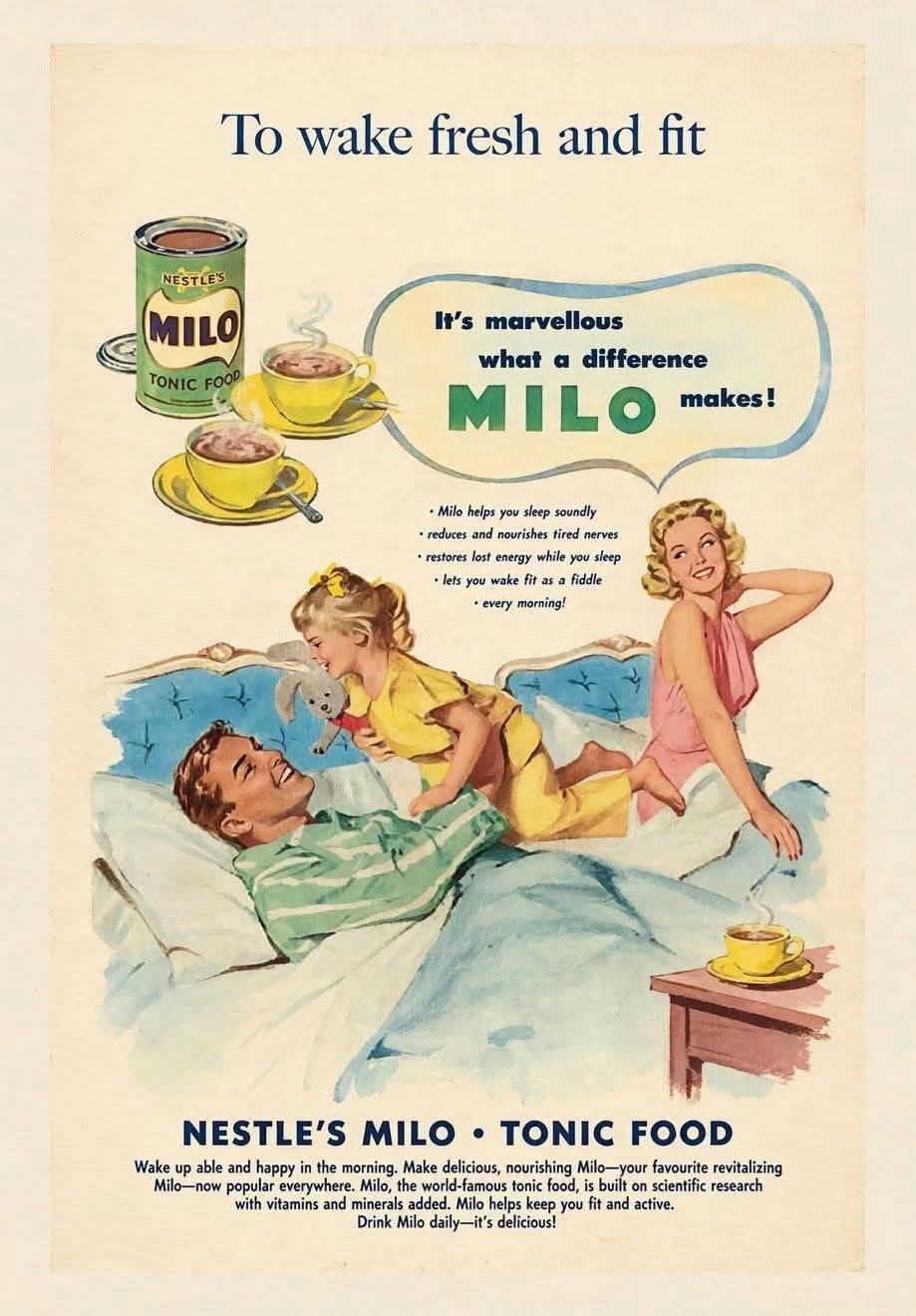
Before MILO became strongly associated with sport, activity, and energy, some of its earlier advertising presented a very different story: a warm bedtime drink followed by restful sleep and a fresh, energetic morning. This mid-1950s campaign shows how food advertising once combined nutrition, rest, family life, and an idealized image of everyday well-being.
Article Content
From Chocolate Drink to “Tonic Food”
MILO was developed in Australia by food scientist Thomas Mayne and launched at the Sydney Royal Easter Show in 1934. Nestlé describes its origins during the Great Depression as an effort to provide children with additional nutrition through a drink made from malt, milk, and cocoa.
Early packaging and advertisements often described MILO as a:
TONIC FOOD
The National Film and Sound Archive of Australia preserves a 1948 MILO advertisement in which the drink is promoted as a fortified tonic food and consumed by members of an entire family, including before bedtime.
Selling the Morning, Not Just the Drink
The advertisement does something clever.
Rather than focusing only on the tin or the taste, it shows the result it wants the viewer to imagine:
a cheerful father,
a playful child,
a refreshed mother,
and a bright family morning.
The product therefore becomes part of a much larger promise:
rest + vitality + family well-being.
A Mid-1950s Campaign
The same advertising theme can be documented in other surviving material.
ABC Australia identifies a MILO poster carrying the familiar “marvellous difference” slogan as dating from 1956, while the National Library of New Zealand’s Papers Past archive preserves a MILO advertisement dated May 10, 1957 that promoted drinking the product before bed and waking refreshed.
For that reason, this image can responsibly be placed within MILO’s mid-1950s advertising campaign.
However, I have not found a primary archive that confirms the exact publication date of this particular page, so it would be inaccurate to assign it a specific year without further evidence.
Before Sport Became Central to the Brand
The way MILO was marketed changed over time.
The Australian NFSA notes that earlier advertising connected the product with the family, health, rest, and sleep, while later branding increasingly emphasized energy, sport, and active young people.
The product survived.
The story surrounding it evolved.
What About the Sleep Claims?
Modern science confirms that sleep itself is essential to health.
The U.S. National Heart, Lung, and Blood Institute explains that sleep supports healthy brain function, physical health, metabolism, and tissue repair.
The NICHD also describes deep sleep as an important restorative stage involving processes such as tissue growth and repair.
But this does not establish that MILO itself causes sound sleep or uniquely “restores lost energy while you sleep.”
Those statements should therefore be read as historical advertising claims rather than modern medical guidance.
What Does This Advertisement Preserve?
It preserves an old MILO tin, mid-century illustration, fashion, and domestic interiors.
But it also preserves something more revealing:
the way “health” was packaged and sold to families in the mid-twentieth century.
The advertisement was not simply saying:
Drink MILO.
It was inviting consumers to imagine:
sleep better, wake fresher, feel stronger, and begin the day as a happy family.
Decades later, the visual language may have shifted from beds and family mornings to sport and activity.
But the marketing principle remains recognizable:
the brand is not selling only the drink—it is selling the feeling associated with what comes next.
“Vintage advertisements preserve more than products; they preserve what an era imagined a healthy, happy, ideal life should look like.”
Memories of Days Gone By ᥫ᭡
Rana Elgogary
Expert Tip
«When you look at a vintage advertisement, don’t ask only: “What was the product?” Also ask: “What kind of life was the advertisement promising people?” Sometimes the world surrounding the product tells us more about its era than the product itself. Memories of Days Gone By ᥫ᭡ Rana Elgogary»
Conclusion
MILO was developed in Australia by Thomas Mayne and launched in 1934. During the 1940s and 1950s, it was frequently presented as a fortified “tonic food” associated with nutrition, health, rest, and energy rather than simply as a chocolate drink. (Nestlé Global) The advertisement belongs to a mid-1950s campaign that connected drinking MILO with sleep and waking refreshed. Related versions of the campaign are documented in 1956 and 1957, although the exact publication year of this particular page has not been independently verified. (ABC News) Modern research confirms that sleep itself plays an important restorative role in physical and brain health, but historical claims that MILO specifically causes sound sleep or restores energy during sleep should be understood as period advertising claims rather than established medical conclusions about the product. (NHLBI, NIH)