5 min read
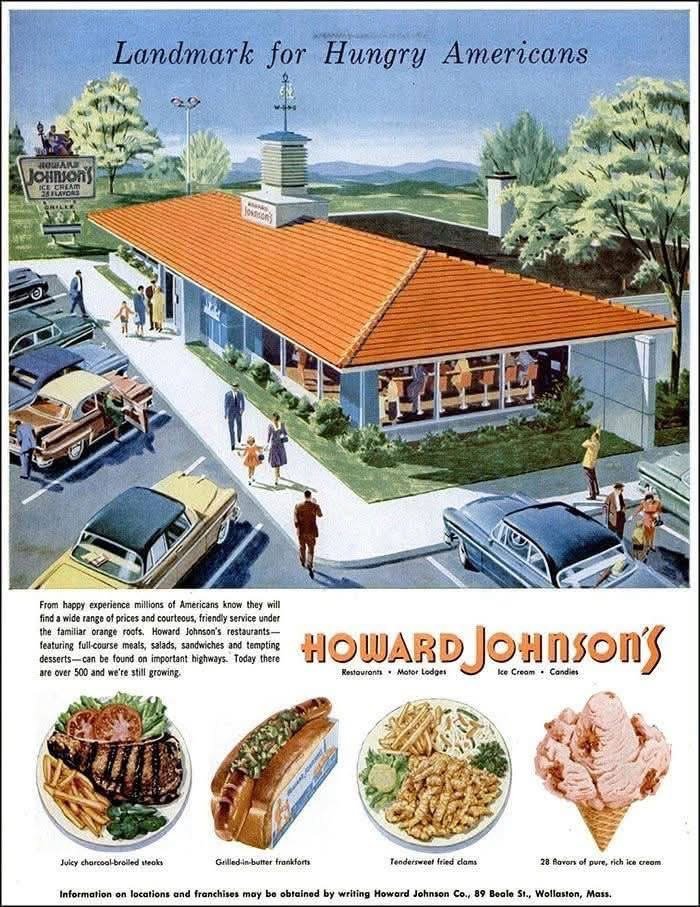
In this 1951 Howard Johnson’s advertisement, an orange-roofed restaurant sits at the center of a busy roadside scene surrounded by cars, travelers, families, and familiar foods. Yet the advertisement documents more than a restaurant. It captures an era when the automobile, the highway, the restaurant, and the journey were becoming part of one experience—and when recognizable visual identity helped travelers know where to stop.
Article Content
A Roadside Restaurant in 1951… When the Meal Became Part of the American Road Trip
At the top of the advertisement is a memorable phrase:
“Landmark for Hungry Americans.”
Look at the illustration, however, and the story becomes much larger than food.
Cars surround the restaurant.
Travelers and families walk toward the building.
Steak, frankfurts, fried clams, and ice cream appear below.
Together, they create a snapshot of America’s developing road-travel culture.
Before Smartphone Maps, the Building Helped You Find Your Stop
Today, travelers can search for nearby restaurants, read reviews, see photographs, and check menus within seconds.
A traveler in 1951 had none of these tools.
Recognition therefore mattered.
The Smithsonian notes that Howard Johnson’s restaurants became instantly recognizable to travelers through their signature orange roofs, signaling a familiar place to dine.
The architecture itself became part of the advertising.
Before you read the sign, the color could tell you where you had arrived.
Why Was the Road So Important?
Howard D. Johnson believed the automobile would help shape America’s future and pursued expansion along its highways.
The first franchised Howard Johnson’s restaurant opened in 1932, and by the end of the 1930s more than 100 locations lined the East Coast.
This created an important promise for travelers:
familiarity in an unfamiliar place.
A recognizable building, familiar food, and an expected level of service could make choosing where to stop easier.
The Advertisement Sells Reassurance as Well as Food
The advertisement emphasizes familiar Howard Johnson’s food, friendly service, and a range of prices.
That reveals something important about branding.
A traveler wasn’t purchasing only a meal.
They were also purchasing a degree of predictability.
When people recognize a brand while traveling somewhere unfamiliar, some of the uncertainty disappears.
That trust becomes part of the product itself.
The Orange Roof Was More Than Decoration
Today, the orange roof may simply look charmingly vintage.
Historically, however, it performed an important branding function.
Its distinctive color and form made Howard Johnson’s easier to identify from the road. The Smithsonian specifically describes the orange-roofed restaurants as instantly recognizable to travelers.
The principle remains relevant:
A strong visual identity isn’t simply a beautiful logo. It is a collection of signals that allows people to recognize a brand quickly.
Food Became Part of the Journey
The advertisement highlights several foods, including steak, frankfurts, fried clams, and ice cream.
Howard Johnson’s was particularly associated with its famous 28 flavors of ice cream, alongside other foods connected with the chain.
The imagery turns the restaurant stop into part of the pleasure of travel:
stop, rest, eat something familiar, and continue the journey.
From Food to Food and Lodging
The idea eventually expanded beyond restaurants.
Howard Johnson’s opened its first motor lodge in 1954, and by the 1960s the company had expanded nationwide, providing travelers with places to eat and stay overnight.
It was a natural extension of the same promise of familiarity.
What Changed—and What Stayed the Same?
More than seven decades later, travel tools look completely different.
We have GPS, smartphone maps, restaurant reviews, online menus, and photographs.
But travelers still want answers to familiar questions:
Where should I stop?
What will I find?
Is it suitable for me?
Can I trust the experience?
In 1951, a traveler might have looked for an orange roof beside the highway.
Today, we may look for a familiar symbol on a phone screen.
What Can a 75-Year-Old Advertisement Teach Us?
Perhaps its most enduring lesson is about consistency.
A brand doesn’t become familiar simply because people repeatedly see its logo.
Recognition becomes meaningful when people associate that logo with a predictable experience.
When appearance, quality, service, and experience reinforce one another, familiarity can become trust.
That helps explain why the advertisement’s phrase was so powerful:
“Landmark for Hungry Americans.”
Howard Johnson’s wasn’t merely trying to become another restaurant beside the road.
It wanted to become the place travelers recognized when they saw it.
“Before smartphone maps told us where to stop for food, the building, sign, and colors beside the road could tell a traveler: you know what you’ll find here.”
Memories of Days Gone By ᥫ᭡
Rana Elgogary
Expert Tip
«When you look at a vintage brand advertisement, don’t examine only its logo. Ask: “What made people recognize this brand before they even read its name?” It may have been a color, architecture, a product, a style of service, or a consistently repeated experience. That is often where the difference begins between a name people know and an identity they remember. Memories of Days Gone By ᥫ᭡ Rana Elgogary»
Conclusion
This 1951 Howard Johnson’s advertisement presents the restaurant as a familiar roadside destination. By the end of the 1930s, the chain already had more than 100 East Coast restaurants, and its distinctive orange roofs helped travelers recognize its locations. The advertisement shows how roadside brands could offer something beyond food: familiarity, trust, and a predictable experience while traveling. Seventy-five years later, the tools we use to find restaurants have changed dramatically, but the traveler’s underlying question remains remarkably familiar: Where should I stop, and what can I expect when I arrive?