5 min read
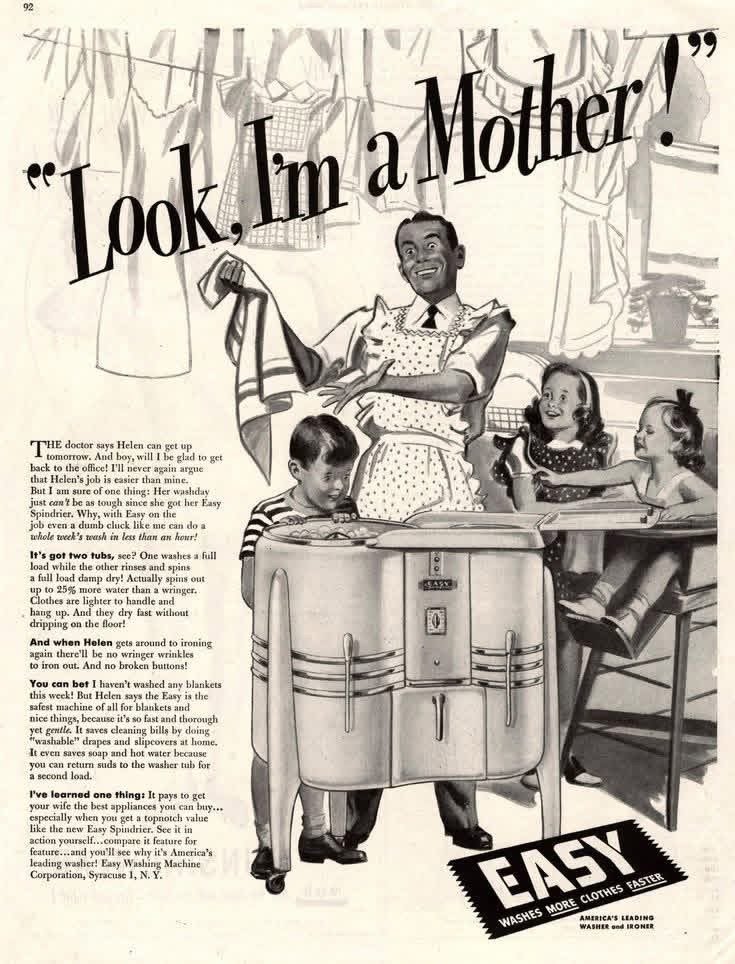
A father in an apron, three children around him, and a twin-tub washing machine at the center of the scene. The headline announces: “Look, I’m a Mother!” In this vintage Easy Spindrier advertisement, Helen is recovering from illness, leaving her husband temporarily responsible for laundry and childcare. The page sells labor-saving technology—but it also reveals how strongly domestic work was associated with women in late-1940s advertising.
Article Content
A Father Takes Over Washday
The humor of the advertisement depends on role reversal.
Helen is temporarily unable to perform her usual household work, so her husband takes over.
The copy even has him acknowledge that he will never again argue that Helen’s job is easier than his.
The message recognizes domestic work as demanding.
At the same time, it clearly assumes that the work normally belongs to Helen.
That is precisely why the headline “Look, I’m a Mother!” is intended to be humorous.
What Made the Easy Spindrier Different?
The machine used two separate tubs.
One handled washing while the other could rinse and spin moisture from another load.
Period Easy advertisements from 1948 promoted the same feature, emphasizing that the two tubs could work simultaneously and that clothes emerged “damp-dry” rather than saturated with wash water.
This was not the automatic wash cycle familiar today.
Clothing still had to be handled and moved through stages.
But reducing water retained in the fabric could make the remaining drying work easier.
The Promise of a Faster Washday
Easy advertisements from 1948 promoted the Spindrier as capable of handling an average family’s weekly wash in less than an hour.
That should be read as a period advertising claim, not an independently verified universal washing time.
Historically, however, it reveals the benefit the company wanted consumers to value most:
less time devoted to laundry.
Why Spinning Mattered
The company also advertised the Spindrier as removing more water than conventional wringer methods, claiming figures of up to 25 percent more in some 1948 advertising.
Again, that percentage belongs to the company’s historical marketing claims.
The practical principle is easier to understand:
less water remaining in clothing meant lighter wet laundry and potentially shorter drying time.
A Design With Earlier Roots
Museums Victoria preserves an early Easy twin-tub washing machine and notes that the underlying design was patented in 1912 and represented a significant development in washing-machine design.
The company itself evolved from the nineteenth-century firm Dodge & Zuill and became the Easy Washing Machine Corporation in 1932. A company history drawing on the Onondaga Historical Association records 1948 as a peak production year, with 474,831 washing machines manufactured.
The Most Interesting Story Is Social
The father’s comment that he will no longer claim Helen’s job is easier than his is revealing.
The advertisement recognizes household labor as real work.
But it does so within another assumption:
that this work normally belongs to the wife.
The father is present as a temporary substitute.
His participation is unusual enough to become the joke.
Technology Reduced Labor Without Necessarily Reassigning It
This pattern appears frequently in mid-century household advertising.
New appliances were promoted as ways to:
save time,
reduce physical effort,
and simplify household routines.
But the advertising message was often not:
“Everyone can now share the work.”
Instead, it was closer to:
“This will make the homemaker’s work easier.”
Technology changed how domestic work was performed before social expectations about who performed it changed to the same degree.
Washing Machines Still Changed Everyday Life
The Powerhouse Collection describes laundry in the nineteenth and early twentieth centuries as highly labor-intensive, involving washing, rinsing, squeezing water from heavy clothing, and hanging it to dry. The development of electric washing machines gradually reduced some of this physical work.
So the advertisement documents more than a stereotype.
It also belongs to a genuine technological transformation in household labor.
From Twin Tubs to Automatic Washing
A contemporary washing machine can automatically move through washing, rinsing, and spinning within one appliance.
The Easy Spindrier belonged to an earlier stage.
Its twin tubs reduced time and physical effort, but the user still managed and transferred the laundry between stages.
That is why vintage technology is best understood not only by comparing it with what we have today, but by comparing it with the work it replaced in its own time.
“Vintage advertisements preserve more than the appliances that entered our homes. They also preserve who was expected to use them—and whose work those machines were designed to reduce.”
Memories of Days Gone By ᥫ᭡
Rana Elgogary
Expert Tip
«When looking at a vintage advertisement for a household appliance, don’t ask only: “What work was this machine designed to save?” Also ask: “Who did the advertisement assume was doing that work before the machine arrived—and who was expected to use it afterward?” Sometimes the appliance tells us the history of technology… while the person standing beside it reveals the history of society itself. Memories of Days Gone By ᥫ᭡ Rana Elgogary»
Conclusion
Easy Spindrier twin-tub washing machines appeared in documented American advertising campaigns during the late 1940s. The company promoted a design in which one tub washed while the second rinsed and spun water from the laundry, with the aim of reducing the time and physical effort involved in washday. Advertisements from 1948 document these features and period marketing claims. The attached advertisement also reveals a social dimension: the father temporarily handles the laundry while his wife is ill, and the headline “Look, I’m a Mother!” reflects the period advertising assumption that laundry and childcare were primarily women’s domestic responsibilities.