5 min read
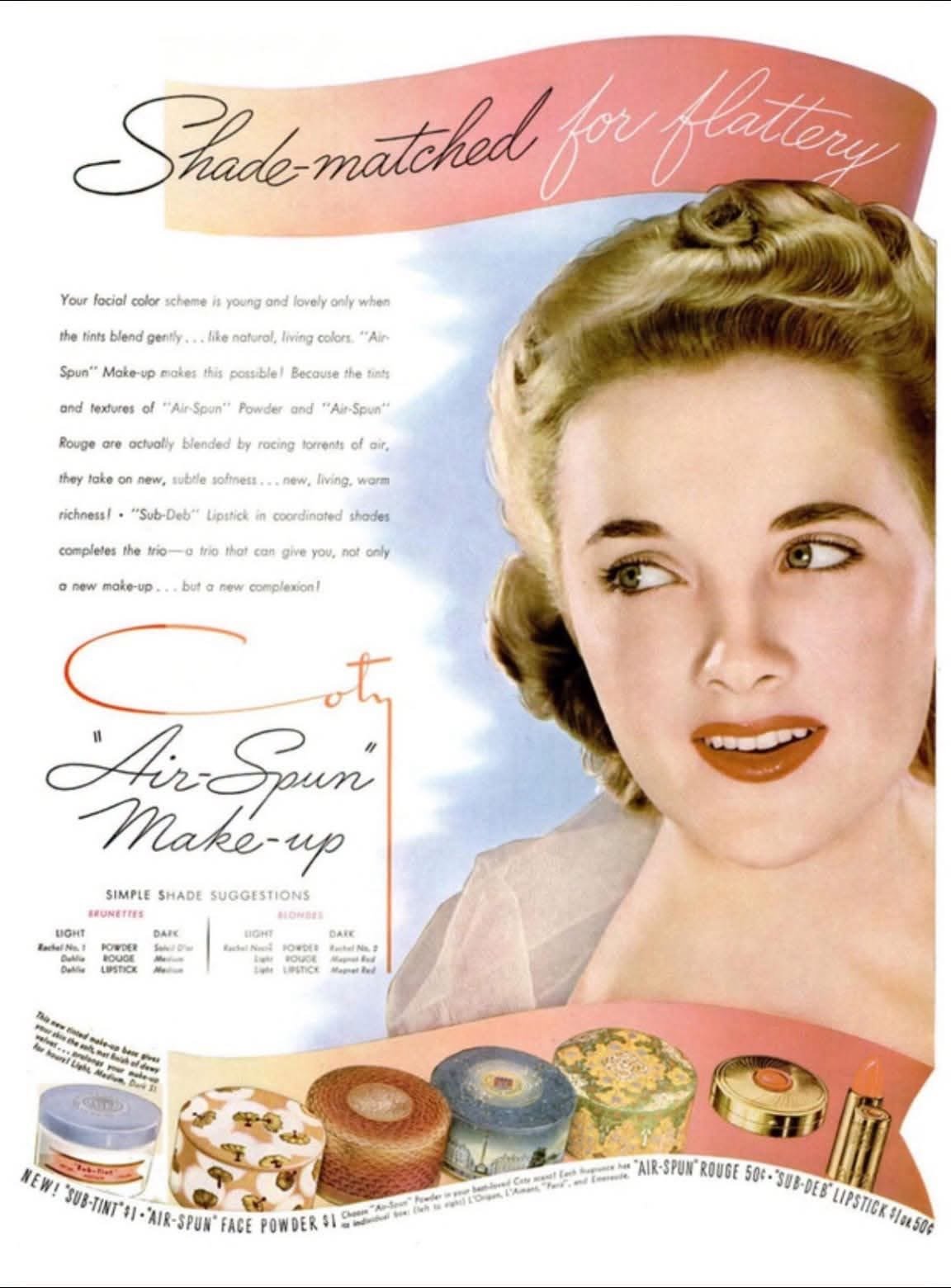
A softly styled face, coordinated colors, and three products designed to work together: powder, rouge, and lipstick. In this vintage Coty advertisement, the phrase “Shade-matched for flattery” captures a broader idea: makeup colors were being marketed not as isolated products, but as a coordinated facial color scheme. The advertisement also reveals how much simpler—and more limited—shade categorization was compared with today’s beauty market.
Article Content
Makeup as a Color Scheme
The advertisement promotes a trio:
Air-Spun Face Powder, Air-Spun Rouge, and Sub-Deb Lipstick.
Its message is not simply to buy three cosmetics.
It is to choose products whose shades have already been coordinated to work together.
Contemporary Coty advertising from 1940 similarly described the colors of Air-Spun Powder, Air-Spun Rouge, and Sub-Deb Lipstick as coordinated into a complete makeup “picture.”
This was an early form of selling makeup as a system rather than a collection of unrelated products.
The Technology Behind “Air-Spun”
The Air-Spun name also referred to a real manufacturing development.
Historical technical sources describe Coty adopting air-powered micronizing technology in the mid-1930s to create smaller and more consistently mixed powder particles. Coty began marketing its Air Spun powder in 1935.
Coty’s own corporate materials also identify 1935 as the year of the Air Spun Face Powder innovation.
Advertising then translated this technical story into a consumer language of:
softness, smoothness, subtle color, and a more refined finish.
Shade Matching Was Much Simpler
The advertisement’s shade suggestions divide consumers into broad categories such as:
blondes and brunettes, light and dark.
This should not be confused with modern undertone analysis or seasonal color analysis.
It was primarily a simplified marketing framework designed to help consumers choose among available shades.
That distinction matters historically.
The beauty industry was already trying to organize color choice—but the categories available to women were far narrower than they are today.
One Product Wasn’t Enough
By coordinating powder, rouge, and lipstick, Coty reduced some of the uncertainty involved in choosing colors.
The message was essentially:
We are not only selling you the products—we are helping determine how their colors should relate to each other.
This transformed shade coordination into part of the product’s value.
Advertising Language Versus Scientific Fact
The advertisement uses ambitious language, even suggesting that the three products could create not merely new makeup but “a new complexion.”
That should be understood as period advertising language, not as a biological or medical claim about changing the skin.
Yet the phrase is historically revealing.
Cosmetics were being sold as tools capable of transforming the overall visual impression of the face, not simply adding pigment.
The Visual Design Reinforces the Message
Soft pink and blue tones.
A highly polished portrait.
Elegant script.
Decorative cosmetic containers.
Everything in the page communicates softness and harmony.
That visual strategy matched Air Spun advertising more broadly, which emphasized smooth texture, fine powder particles, and softly blended color.
Packaging Was Part of the Beauty Experience
Coty historically placed significant attention on package design.
The Powerhouse Collection preserves an Air Spun compact dated broadly to around 1935–1955 and notes that Coty’s powder-box design evolved from work associated with artist Léon Bakst.
Beauty products therefore occupied two roles:
something to use,
and something attractive enough to display on a dressing table.
What the Advertisement Also Reveals
The beauty ideal shown in the advertisement is narrow by modern standards.
Its face, shade categories, and assumptions do not represent every woman living at the time.
Instead, they reveal the consumer and beauty ideal the advertiser chose to imagine.
That is one reason vintage advertising is valuable for historical study.
Duke University’s Ad*Access collection preserves more than 7,000 print advertisements from 1911–1955, including 2,391 advertisements categorized as Beauty and Hygiene, allowing researchers to examine how commercial images of beauty changed across decades.
From Shade-Matched Makeup to Today’s Choices
Today’s beauty market uses far broader shade ranges and more nuanced discussions of undertones and individual preference.
But one principle from this old Coty advertisement still feels familiar:
Color does not exist in isolation.
Lip color interacts with the complexion.
Rouge interacts with the other tones on the face.
The final appearance comes from relationships among colors—not simply from each product individually.
The systems changed.
The choices expanded.
But the fundamental styling question remains:
How do the colors work together?
“Vintage beauty advertisements preserve more than the makeup colors of their era. They preserve the way each period learned to think about beauty, color, and harmony.”
Memories of Days Gone By ᥫ᭡
Rana Elgogary
Expert Tip
«When studying a vintage makeup advertisement, don’t ask only: “What colors were fashionable?” Also ask: “How did they decide who those colors were supposed to suit?” Sometimes the way shades were classified tells us more about an era’s idea of beauty than the lipstick color itself. Memories of Days Gone By ᥫ᭡ Rana Elgogary»
Conclusion
In the early 1940s, Coty marketed its Air-Spun makeup products as a coordinated system of powder, rouge, and lipstick shades. The Air Spun manufacturing concept itself had emerged in the mid-1930s as a new method of creating finer, more consistently processed face powder. The advertisement also illustrates how shade selection was simplified into broad categories such as hair color and general coloring, long before the much wider shade systems available today.