5 min read
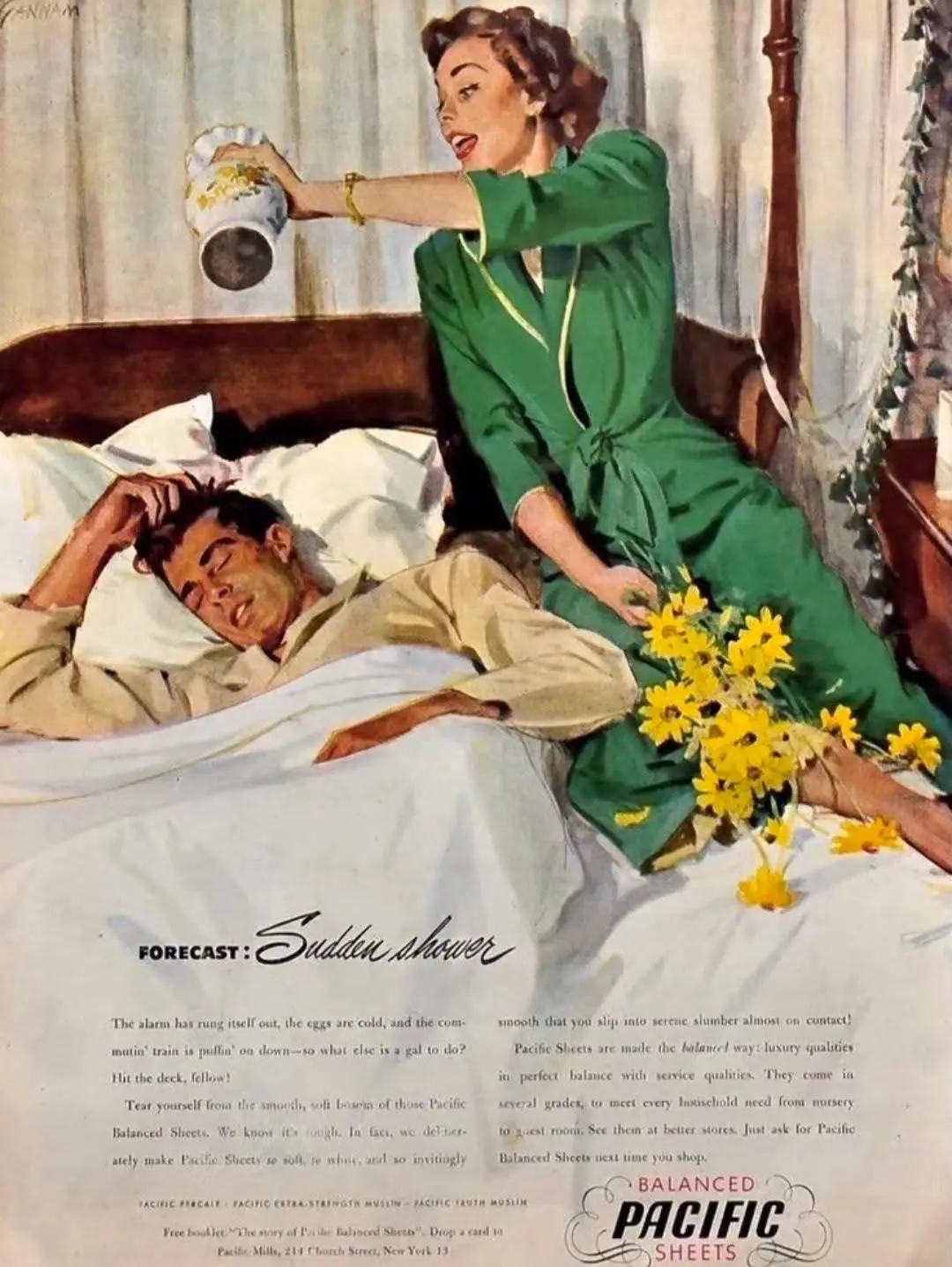
The alarm has rung, breakfast has gone cold, and the commuter train is nearly leaving—but the man is still in bed. In this 1948 Pacific Balanced Sheets advertisement, the woman resorts to a humorous solution: a pitcher of water and a “sudden shower.” Rather than beginning with fabric specifications, the advertisement sells a simple feeling: these sheets are so comfortable that leaving the bed becomes difficult.
Article Content
“Forecast: Sudden Showers”
An archived version from 1948 contains the same copy seen in the advertisement: the alarm has finished ringing, breakfast is cold, and the commuter train is moving on.
The water is not the product.
It is the visual joke that leads to the product claim.
Pacific wants the reader to associate its sheets with exceptional softness and comfortable sleep.
Selling the Experience
Instead of merely listing:
softness,
whiteness,
strength,
and durability,
the advertisement creates a small story.
A man will not get out of bed because he is too comfortable.
The product attribute—softness—has been translated into an experience the reader can imagine.
Modern advertising still uses the same principle:
show the result or feeling associated with a product, not only its technical features.
What Did “Balanced” Mean?
Pacific marketed the product as Pacific Balanced Sheets.
Archived advertisements from the period explain “balanced” as a combination of comfort qualities such as softness with service qualities such as strength and durability.
The company offered different grades, including Pacific Percale, Pacific Extra-Strength Muslin, and Pacific Truth Muslin.
“Balanced,” however, should be understood as the brand’s own marketing concept rather than an independent scientific certification.
Information Still Mattered
Pacific also promoted a product label called the Pacific Factbook, which supplied buyers with information including size, weave, thread count, weight, shrinkage, finish, and other textile characteristics.
The campaign therefore combined two approaches:
emotion to attract attention,
information to support the purchase.
A Historic Textile Company
Cornell University’s Kheel Center describes Pacific Mills of Lawrence, Massachusetts as textile printers, dyers, and bleachers that manufactured cotton and worsted goods.
Its surviving records are part of major American textile-history collections, reflecting the company’s long history in the industry.
What Does This Advertisement Preserve?
It preserves more than an old set of sheets.
It captures a style of advertising that turned a basic household product into a memorable domestic scene.
Almost eighty years later, the joke still works:
the bed is so comfortable that someone has to be forced out of it.
“Sometimes a vintage advertisement succeeds because it does not explain the product—it makes us imagine the feeling the brand wants us to associate with it.”
Memories of Days Gone By ᥫ᭡
Rana Elgogary
Expert Tip
«When you look at a vintage advertisement, ask: “Is it selling me the product itself—or the feeling it wants me to associate with that product?” Sometimes the story in the picture communicates more than all the specifications printed beneath it. Memories of Days Gone By ᥫ᭡ Rana Elgogary»
Conclusion
The 1948 Pacific Balanced Sheets “Forecast: Sudden Showers” advertisement uses a humorous scene of a man reluctant to leave his bed to promote the comfort and softness of Pacific sheets. Period advertising described the brand’s “balanced” concept as combining comfort qualities with durability and practical performance. The page also demonstrates a marketing principle that remains familiar today: sell the experience and feeling of the product, then support that emotional message with practical information.