5 min read
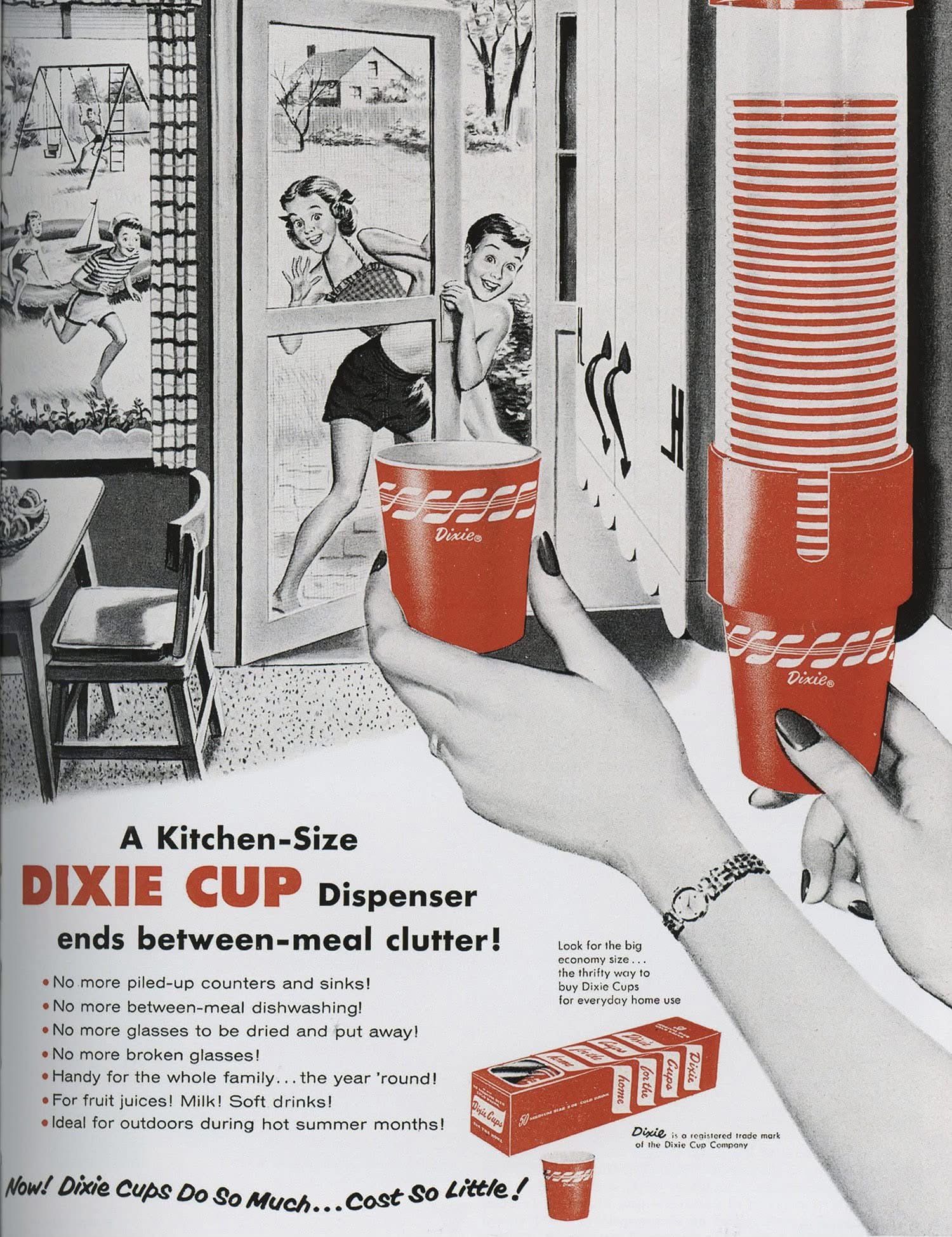
In this vintage Dixie Cups advertisement, the paper cup wasn’t presented simply as something to drink from. It was promoted as a solution to an everyday household problem: fewer glasses in the sink, less washing, less drying, and less putting away. The advertisement offers a fascinating glimpse into the changing meaning of convenience at home.
Article Content
The Paper Cup in the Kitchen… When Convenience Meant Less Washing
Two children return from playing outside.
A mother stands in the kitchen.
A paper cup is ready in her hand.
It seems like an ordinary scene today.
But the advertisement wasn’t merely trying to sell paper cups.
It was promising something else:
less time at the kitchen sink.
Its headline reads:
“A Kitchen-Size Dixie Cup Dispenser ends between-meal clutter!”
The advertisement then emphasizes what the homemaker would no longer have to deal with: glasses piling up, between-meal dishwashing, drying and putting glasses away, and broken glassware.
The idea was remarkably simple:
use the cup—and eliminate the task that normally follows it.
But the Paper Cup Began With a Different Problem
The origins of the individual paper drinking cup were closely connected to public health.
Lawrence Luellen began developing an individual paper cup in 1907. The Public Cup Vendor Company was formed with Hugh Moore in 1909, and by 1912 the product was known as the Health Kup. It became the Dixie Cup in 1919.
Early marketing was closely connected to campaigns against communal drinking cups in public places.
The original promise was essentially:
one clean cup for one person instead of a drinking vessel shared by everyone.
Over time, however, the marketing message evolved.
From Public Hygiene to Household Convenience
This advertisement takes us into a very different setting:
the family kitchen.
Dixie’s records show that the company introduced its successful Home Line in 1949 as part of its postwar expansion.
The problem the product promised to solve was therefore no longer only about hygiene.
It was also:
How can everyday household life require less work?
Why Are the Children Important?
The children help explain the problem visually.
Between meals, family members might repeatedly want water, juice, milk, or a soft drink.
Each traditional glass created another tiny sequence of work:
use it,
wash it,
dry it,
put it away.
The disposable cup promised to remove that sequence.
This illustrates something important about domestic convenience:
some innovations didn’t save hours at once—they tried to eliminate small tasks that repeated throughout the day.
The Advertisement Sells What You Won’t Have to Do
Much of the copy is built around the phrase:
“No more…”
No more clutter.
No more between-meal dishwashing.
No more drying and putting glasses away.
No more broken glasses.
The real selling point wasn’t what the cup could do.
Any cup could hold a drink.
The selling point was the work that supposedly disappeared after the drink was finished.
We still recognize this marketing strategy today.
Products often promise not simply an object, but:
less time,
fewer steps,
less cleaning,
less waiting,
or less effort.
Convenience Was Designed Into the Kitchen
The advertisement doesn’t show only a package of cups.
It prominently features a kitchen-size dispenser.
That matters because a product with a permanent place in the kitchen can become part of an everyday routine:
take a cup,
use it,
discard it.
Convenience was becoming something that could be built into the organization of the home itself.
But Today We See Another Side of Convenience
From a contemporary perspective, a product designed for one use raises another question:
What happens after we throw it away?
That doesn’t mean we need to judge the past simply by today’s standards.
Instead, the advertisement allows us to see how priorities change.
Individual cups originally gained importance partly through public-health concerns about shared drinking vessels.
Later, disposability could also be promoted as household convenience.
Today, our idea of convenience increasingly has to include another consideration:
Is the convenience worth the resources and waste it creates?
What Does This Advertisement Tell Us Today?
The history of everyday life isn’t made only from spectacular inventions.
Sometimes it lives inside very small things:
a cup,
a kitchen dispenser,
a sink someone wants to keep clear,
and a household trying to reduce repetitive chores.
Vintage advertisements therefore don’t only tell us:
What were people buying?
They can also help us ask:
What everyday problem were they trying to solve—and what did “convenience” and “progress” mean to them?
“Vintage advertisements don’t only reveal what people bought. They also reveal the small everyday problems industry promised to make easier.”
Memories of Days Gone By ᥫ᭡
Rana Elgogary
Expert Tip
«When you look at a vintage household advertisement, don’t look only at the product. Ask: “What everyday task was this product promising to remove?” You may discover that much of the history of domestic life can be found in the small minutes people were trying to get back. Memories of Days Gone By ᥫ᭡ Rana Elgogary»
Conclusion
The Dixie Cup began in the early twentieth century within the broader move toward individual drinking cups and away from communal drinking vessels. Over time, Dixie expanded into the household market. In this vintage advertisement, the message is distinctly domestic: less washing, less clutter, less drying, and less putting away. Today, the advertisement can be read from two perspectives at once: as part of the history of household convenience, and as a reminder that our modern definition of convenience increasingly includes questions about consumption and waste.