5 min read
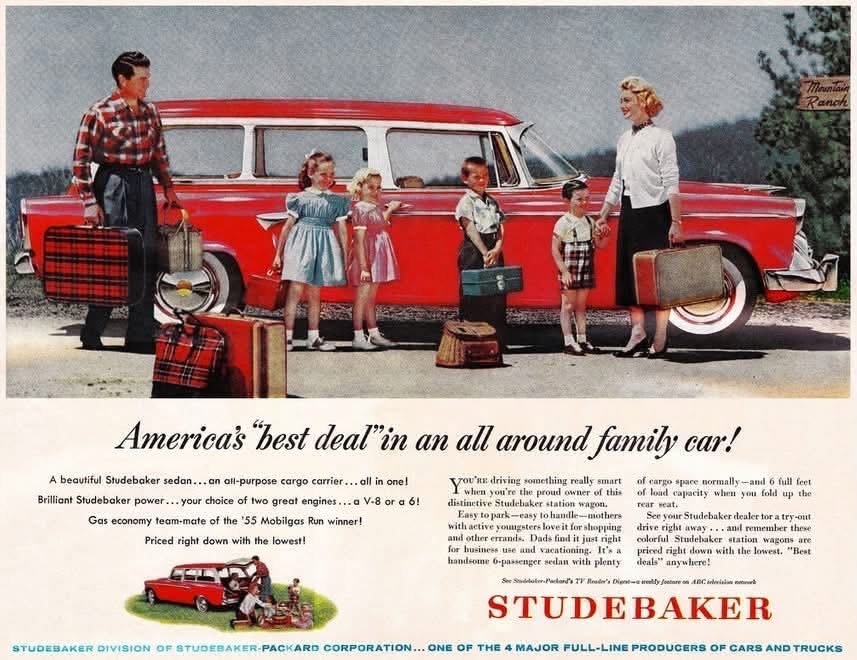
A family, children, travel cases, and a bright red Studebaker ready for the road… This 1955 advertisement wasn’t simply presenting a car. It was presenting the automobile as part of a mobile, active family life. Today, we return to the 1950s to look beyond the car itself and ask a more interesting question: What kind of life was the advertisement really selling?
Article Content
The Car Isn’t the Only Star
The headline describes Studebaker as:
“America’s ‘best deal’ in an all around family car!”
But instead of showing the automobile alone, the advertisement surrounds it with the life it is supposed to serve.
Parents. Children. Luggage. An open outdoor setting.
Before reading the copy, we already understand the message:
This is a car for a family going places.
Why So Much Luggage?
The luggage is doing an important job visually.
The advertisement emphasizes passenger accommodation, cargo space and the car’s usefulness for family activities, shopping, travel and other purposes.
Rather than merely telling readers that the vehicle offers useful space, the image helps them imagine using that space.
It turns a product feature into a life experience.
And that advertising principle remains familiar today:
Don’t simply show people what a product has.
Show them what its features allow them to do.
Fuel Economy Was Part of the Story Too
The advertisement also refers to Studebaker’s performance in the 1955 Mobilgas Economy Run.
Contemporary newspaper coverage confirms that the Studebaker Commander Custom V-8 won the Sweepstakes Trophy, completing the 1,323-mile route with an actual fuel economy of approximately 27.4 miles per gallon.
Studebaker subsequently made this achievement a prominent part of its advertising during 1955.
The message feels surprisingly modern:
A family car should not only look desirable.
It should also make practical sense to operate.
The Family Portrait Tells Us About Its Era
The advertisement is also interesting as a piece of visual culture.
It presents an idealized image of family life: parents, children, luggage, a large automobile and the possibility of travel.
That does not mean every American family actually lived this way.
Advertising shows us what companies believed would be aspirational and persuasive to their audiences, rather than providing a complete picture of everyday society.
And that distinction makes vintage advertising particularly valuable to examine.
Look at the Clothes, Too
Even the clothing contributes to the story.
The family appears neat and carefully presented. The children are dressed for the scene, the parents look composed, and even the luggage contributes to the visual arrangement.
Travel isn’t presented as stressful preparation.
It becomes an attractive image of organized family life.
The car may be the product.
But the lifestyle is the story.
From 1955 to Today
Cars have changed dramatically.
Technology has changed.
Modern advertising now emphasizes screens, connectivity, cameras and driver-assistance features.
Yet many of the questions behind a family’s choice remain recognizable:
Who will travel in it?
What will we carry?
Where will we go?
Will everyone be comfortable?
Does it fit our everyday life?
That is why an advertisement more than seventy years old can still feel strangely familiar.
The technology changes. Many human needs do not.
What Can This Advertisement Teach Us?
Perhaps the most fascinating thing about vintage advertising is its ability to preserve both a product and the imagined life surrounding it.
The red Studebaker tells us something about automobiles of the 1950s.
The children, luggage, clothes and setting tell us something else:
They reveal how advertisers wanted consumers to imagine life with that automobile.
So when we look at an old advertisement, perhaps the most interesting question isn’t:
“What were they selling?”
It is:
“What kind of life were they selling with it?”
“Vintage advertisements preserve more than the cars that once traveled the roads… they also preserve images of the lives people imagined those cars might take them toward.”
Memories of Days Gone By ᥫ᭡
Rana Elgogary
Expert Tip
«The next time you look at a vintage advertisement, don’t examine only the product. Look at the people, clothing, setting and objects around it, and ask: What kind of life is this advertisement inviting me to imagine? Sometimes the most interesting story is not inside the product at all. It is everything surrounding it. Memories of Days Gone By ᥫ᭡ Rana Elgogary»
Conclusion
This 1955 Studebaker advertisement presents much more than an automobile. By surrounding the car with parents, children and travel luggage, it connects the product with mobility, family life and travel. Its emphasis on practicality and fuel economy also reflects concerns that remain familiar to car buyers today. Vintage advertisements like this can therefore be read not only as commercial material, but also as windows into the aspirations and idealized lifestyles marketers associated with their products.