5 min read
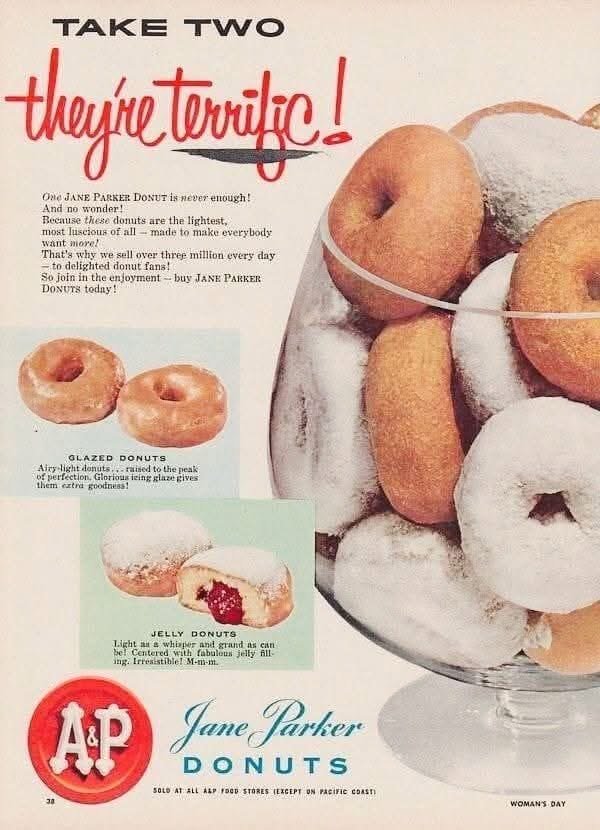
A glass bowl overflowing with donuts, several varieties on display, soft colors, and a headline that says: “Take Two… they’re terrific!” This vintage Jane Parker Donuts advertisement shows how A&P turned an everyday bakery product into something designed to create immediate appetite.
Article Content
Donuts in Mid-Century America… When an Appetizing Image Sold More Than a Sweet Treat
The first thing you notice is not the company name.
It is the food.
Donuts fill much of the advertisement: glazed, powdered and filled varieties, photographed closely enough to make texture part of the appeal.
Then comes the invitation:
“Take Two… they’re terrific!”
The advertisement is not trying to convince readers that donuts are necessary.
It is trying to create desire.
When the Product Was the Hero
The visual strategy is remarkably direct.
Make the food prominent.
Describe it with sensory words.
Keep the background simple.
Let appetite do much of the selling.
Descriptions of the glazed and jelly donuts emphasize lightness, texture and generous filling.
Rather than explaining technical details about production, the copy encourages the reader to imagine what eating the product might feel like.
Jane Parker Was an A&P Brand
Jane Parker was not simply an unrelated bakery advertised inside A&P stores.
The Smithsonian National Museum of American History identifies Jane Parker as an A&P house brand. Its archive includes a 1947 Jane Parker advertising book connected with A&P stores and Jane Parker pastry chefs.
This makes the advertisement an interesting example of what we now call a private label.
A&P did more than sell products made by other companies. It developed and manufactured products under its own brands, including Jane Parker bakery goods.
Magazine, Store, and Product
The bottom of the advertisement tells readers that the donuts were sold through A&P Food Stores.
That connection becomes even more interesting because Woman’s Day itself began with A&P.
A contemporary TIME report from 1937 described the magazine as an A&P venture focused on household usefulness and helping women use the food they purchased.
By the 1950s, Woman’s Day was distributed through thousands of A&P stores before the chain sold the magazine in 1958.
The business model was remarkably integrated:
The retailer owned the product.
The magazine reached the retailer’s customer.
The advertisement promoted the product.
And the reader could buy it inside the same retail network.
What About the “Three Million a Day” Claim?
The advertisement states that more than three million donuts were sold every day.
That number is interesting—but it should be read carefully.
I have not found an independent reliable source confirming that specific sales figure.
So it is best treated as what it is:
a marketing claim made by the advertisement itself.
Vintage advertisements are valuable historical evidence for understanding how companies presented themselves, but they are not automatically independent verification of every claim they contain.
Why “Take Two”?
The headline does not simply say:
Buy our donuts.
It tells the reader to:
Take two.
The copy reinforces the same message by suggesting that one Jane Parker donut is never enough.
It is a clever piece of persuasion.
Abundance becomes part of the appeal.
The bowl is full.
There are multiple varieties.
And the reader is encouraged to imagine wanting another before even tasting the first.
Variety Changes the Question
The ad identifies glazed donuts and jelly donuts, while several other shapes are visible in the main display.
Variety subtly changes the consumer’s question.
Instead of:
“Do I want a donut?”
it becomes:
“Which donut do I want?”
That is a small but powerful shift in advertising.
More Than a Donut Advertisement
At first glance, this is simply an attractive page selling baked goods.
Look more closely and it becomes a document about:
supermarket history,
private-label branding,
women’s service magazines,
food photography,
and the way ordinary products were given distinct identities.
Vintage advertising therefore helps us ask not only:
What did people buy?
but also:
How were they taught to want it?
“Vintage advertisements preserve more than the appearance of old products. They also preserve the words and images brands used to turn everyday things into objects of desire.”
Memories of Days Gone By ᥫ᭡
Rana Elgogary
Expert Tip
«When you look at a vintage food advertisement, don’t ask only: “What are they selling?” Also ask: “How are they making me want it before I have tasted it?” Study the size of the product, color, quantity, wording and composition. Sometimes an old advertisement reveals as much about the selling techniques of its era as it does about the food itself. Memories of Days Gone By ᥫ᭡ Rana Elgogary»
Conclusion
Jane Parker was an A&P house brand for bakery products, a relationship documented by the Smithsonian National Museum of American History. The advertisement demonstrates how appetite appeal, variety, sensory language and abundance could turn a simple supermarket product into a branded experience. It also provides a useful reminder to distinguish between claims made by advertisements and facts independently verified by historical sources.