5 min read
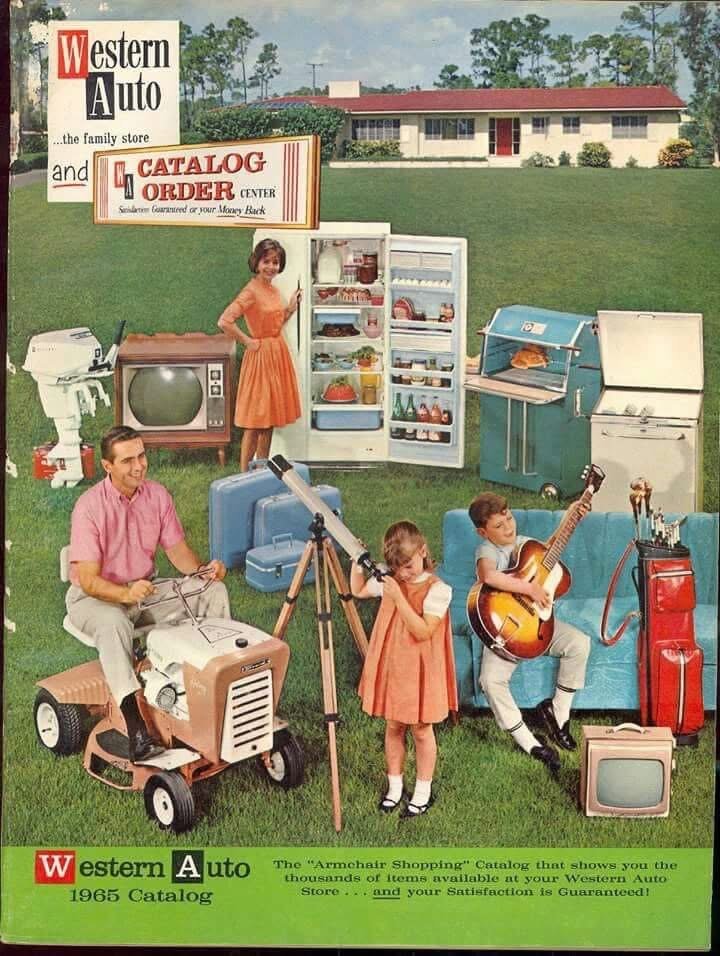
Long before online stores and shopping apps, families could sit at home, browse hundreds of pages filled with products, and order what they wanted through a catalog. This 1965 Western Auto advertisement places an extraordinary range of products in front of a single family home, capturing an earlier version of a familiar modern idea: shopping without having to see everything inside a physical store.
Article Content
Shopping in 1965… When the Catalog Brought the Store Home
Look closely at the advertisement.
A refrigerator, televisions, household appliances, a grill, lawn equipment, a telescope, a guitar, sporting goods—and an entire family surrounded by them.
It almost looks as though a whole store has been moved onto the front lawn.
That was precisely the strength of the message:
the catalog could give families access to far more than what they saw on a store shelf.
Before the Screen, There Were Pages
Today, we open an app, search for an item, compare options, and place an order.
In the 1960s, catalogs performed some of those same functions.
In 1964, TIME reported that U.S. catalog sales had grown about 60% over the previous decade, describing catalog retailing as a rapidly growing part of the industry. Western Auto was distributing millions of catalogs offering automotive supplies, appliances, and sporting goods through thousands of outlets.
The idea of shopping from home, then, did not begin with the internet.
The tool changed.
Thousands of Choices in One Catalog
A contemporary 1964 Western Auto advertisement promoted a 320-page catalog containing more than 16,000 items for the home, recreation, and automobile.
It even emphasized the convenience of shopping from an armchair while avoiding crowds and parking problems.
The similarities with modern e-commerce are striking.
Why Put Everything on the Lawn?
The 1965 image isn’t built around one hero product.
Instead, it shows a family’s whole lifestyle.
Home appliances sit beside entertainment, gardening equipment, children’s hobbies, and recreation.
The message becomes much broader than “buy this refrigerator.”
It suggests:
Whatever your family needs, look for it in the catalog.
The house in the background completes the story.
These aren’t isolated objects.
They’re being presented as things that could become part of everyday family life.
The Catalog Was Also a Discovery Tool
A large catalog could introduce families to products they hadn’t planned to buy—or perhaps didn’t even know existed.
That made it more than an ordering system.
It became a tool for browsing, discovering, and imagining.
The behavior is remarkably familiar.
We may enter an online store today looking for one item and soon find ourselves browsing ten others.
The medium changed. The instinct to browse did not.
The Telephone Became Part of Shopping Too
By the mid-1960s, catalog shopping was increasingly connected with telephone ordering.
In 1966, TIME described how major retail catalogs had evolved into telephone-order tools, particularly for younger families and suburban consumers.
Western Auto advertising from the period similarly promoted its catalog-order service as being as close as the telephone.
A paper page instead of a screen.
A telephone instead of an app.
A catalog center instead of today’s digital fulfillment systems.
Yet the basic idea feels surprisingly modern.
The Advertisement Was Selling a Lifestyle Too
This image is also a document of mid-century consumer culture.
The spacious home, green lawn, modern appliances, leisure activities, and children’s hobbies together create an idealized picture of comfortable family life.
Western Auto wasn’t simply showing what could be purchased.
The advertisement was also showing the life those purchases were imagined to support.
And advertising still does exactly that.
From Paper Catalog to Digital Cart
More than sixty years later, much of the paper catalog’s everyday role has moved onto screens.
Search is faster.
Comparison is easier.
The range of products can be enormous.
Purchasing can take seconds.
Yet look at this 1965 advertisement again and its central promise remains remarkably recognizable:
many products, many choices, and the convenience of finding them in one place.
In the End…
The 1965 Western Auto advertisement preserves more than old televisions, refrigerators, and lawn equipment.
It captures an important stage in the evolution of how people shopped.
The store was beginning to reach consumers through pages, catalog centers, and the telephone.
Today those pages have largely become a screen we carry everywhere.
But the desire remains familiar:
more choice, easier comparison, and greater convenience.
“Before the phone screen became our window onto thousands of products, catalog pages performed a remarkably similar role… the tools of shopping changed, but the pleasure of browsing and choosing remained.”
Memories of Days Gone By ᥫ᭡
Rana Elgogary
Expert Tip
«The next time you buy something from your phone in minutes, remember that the idea of shopping from home is much older than the internet. Technology changed the speed and the tools—but not our desire for convenience, choice, and easy comparison. Memories of Days Gone By ᥫ᭡ Rana Elgogary»
Conclusion
This 1965 Western Auto advertisement captures a period when catalogs and catalog-order centers gave consumers access to thousands of products beyond what might be displayed locally. Catalog retailing was expanding rapidly in the mid-1960s, while Western Auto was developing its catalog-order network and promoting broader product selection through catalogs and telephone ordering.